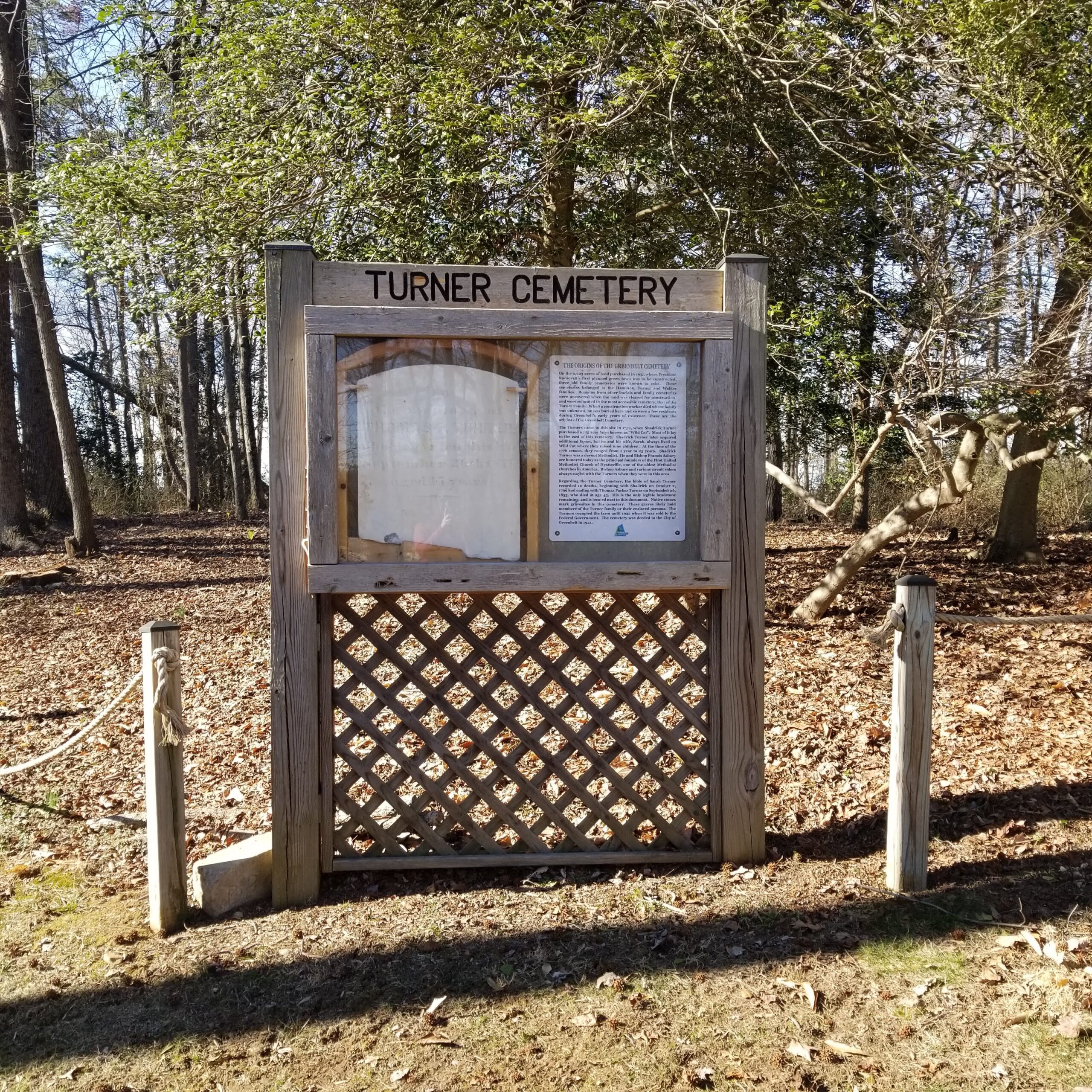
The Greenbelt City Council’s June 10 worksession covered two main topics: the draft cemeteries master plan and the budget process. This article reports on the cemeteries plan.
Carolyn Gimbal, senior architectural historian with Johnson, Mirmiran & Thompson, Inc. (JMT), presented the latest version of the Historic Greenbelt Cemeteries Master Plan. The plan outlines a strategy for the preservation, maintenance and use of three historic family cemeteries: Hamilton, located at the end of Hamilton Place; Turner, located within the Greenbelt Cemetery on Ivy Lane; and Walker, located behind an office building at the end of Walker Drive. While there likely are other family cemeteries within the boundaries of what is now Greenbelt, these three cemeteries were specifically included in the Greenbelt Historic District National Historic Landmark (NHL) ― nps.gov/places/greenbelt-historic-district.htm ― because Greenbelt’s founders identified them as points of interest for the new town and its residents due to both their historical significance and recreational potential. Being a part of the NHL makes the cemeteries eligible for a broader range of grant funding than they otherwise would be.
Plan Development
JMT began work on the plan in 2025, partially funded by a grant the City of Greenbelt obtained from the Maryland Heritage Areas Authority. Gimbal presented the first draft at a community meeting on July 23, 2025 (see the August 14, 2025 issue) and at a council worksession in October 2025 (see the November 6, 2025 issue). Another community meeting was held on March 24, 2026 to present the second draft of the plan; input from community members and others was collected at the meeting and during a public comment period. Associated with the current draft is a comment response matrix, a table of 125 comments made by the public or by professional reviewers and Gimbal’s response to each. Gimbal now considers the plan, included online in the worksession’s agenda packet, to be 95 percent complete although she views it as a living document that can be amended in the future by city officials or staff.
Historical Context
The cemeteries are burial sites for members of the Hamilton, Turner and Walker families but likely also contain the remains of persons they enslaved. The plan includes considerable historical information on the families, including some basic family trees. Gimbal compiled genealogical data from Ancestry.com, census records and wills and tracked down a Turner family Bible held by First United Methodist Church of Hyattsville, in which matriarch Sarah Turner recorded family births, deaths and marriages, and logged births and deaths of enslaved persons from 1825-1850.
Recommendations
The plan recommends several steps the city should take to establish a sustainable strategy to restore and maintain these cemeteries: 1) establish a cemeteries maintenance team; 2) establish a seasonal routine maintenance schedule; 3) make critical site repairs and improvements; 4) repatriate the removed grave markers; 5) install new interpretive signage or monuments; and 6) establish heritage programming.
Site-specific Recommendations
Hamilton Cemetery, which is next to a community garden field, is overgrown with vines and shrubs, and these should be cleared. The cemetery boundaries are not visible on the ground, but Gimbal mapped a square patch that is covered by vinca, a plant that commonly was planted in cemeteries. She recommends that a chain-link fence be erected around that square, which almost certainly lies within the cemetery. “Does it have to be chain link?” councilmembers almost unanimously wondered. Gimbal explained that preservationists recommend modern materials for fencing historic cemeteries rather than wood or other materials that could be perceived to represent the period the site was in use. Gimbal offered to research fencing options that are more attractive than chain link but would serve to delineate the site.
Turner Cemetery is basically in good shape but the existing partial fence should be replaced with a fence that fully bounds the cemetery. The existing chain link fence at Walker Cemetery still is in good condition but eventually should be replaced. The highest priority for this site is improving the access trail, which should be done soon. Resident
J Davis noted that the local chapter of Daughters of the American Revolution, which maintains this cemetery because two Revolutionary War veterans are buried there, cancelled their annual Memorial Day cleanup because the trail condition made access difficult for some participants.
Headstone Repatriation
Some Hamilton Cemetery headstones have been stored by Public Works since their removal from an onsite display case that had deteriorated. Gimbal recommends that they be returned to the cemetery, placed in a newly designed display case rather than laid out in a way that implies presence of a grave. Locations of graves are not known at any of these cemeteries. Because the three cemeteries are in wooded areas, Gimbal believes that trees and tree roots would limit the usefulness of ground-penetrating radar for locating graves and does not recommend it.
Council Questions
Council complimented Gimbal’s thorough and thoughtful work on the plan. Councilmember Danielle McKinney asked Greenbelt Museum Director Megan Searing Young, who oversees the JMT contract with Acting Director of Planning & Community Development Jaime Fearer, if the cemeteries are integrated with Museum programs. Searing Young responded that they are not currently on Museum walking tours but are included in the city’s way-finding plan and information on the cemeteries can be added to wayside panels and will be featured in the Museum’s new education center. In response to a question from Councilmember Frankie Fritz, she said the Reparations Commission has Gimbal’s information on burials of enslaved persons and intends a memorialization project to recognize these burials.
Responsibility
Searing Young said thought must be given to where responsibility for the cemeteries should reside within city government — in Public Works or Planning & Community Development? And would they fall within the purview of an existing advisory board? She suggested that a Friends group be formed to monitor the cemeteries, which Davis endorsed. Davis also urged that a maintenance plan be made and implemented before other steps of the plan, which likely will be eligible for grant funding.