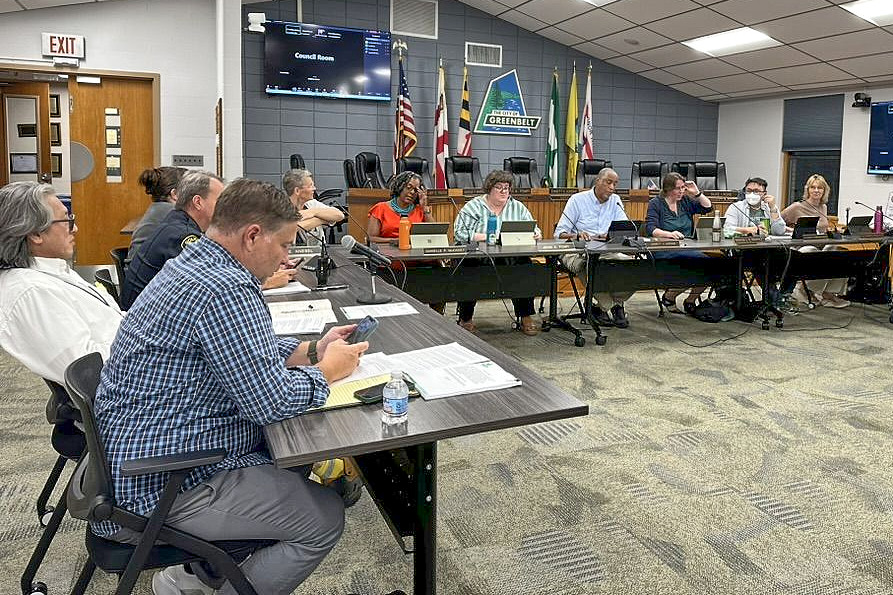
City Manager Josué Salmerón, accompanied by the city’s program directors, met with the Greenbelt City Council on September 9 in a worksession to discuss the actions taken in response to the Justice, Equity, Diversity and Inclusion (JEDI) audit presented in April 2025 and to assess the next steps for the Diversity, Equity and Inclusion (DEI) program. The JEDI report, generated by Tribesy Consulting, identified organizational structural and cultural barriers to DEI. It also made recommendations to help the city become more inclusive, to build trust among employees and with the community, and to generate accountability. The two volumes of the report are available at tinyurl.com/4234f8va.
Inclusive Values
The JEDI audit identified organizational structure issues that inhibit DEI under the purview of the council as well as the city administration. Following the recommendation of the auditors, council rewrote the city code to reflect inclusive values. The JEDI team, made up of employee volunteers, developed a JEDI vision and generated operational definitions for justice, equity, diversity and inclusion which are being infused into city practices. Human Resources has reviewed and is revamping its policies and procedures. The former DEI coordinator instituted a leadership training program which features flexible on-demand modules. The city is currently developing an inclusive decision-making tool.
The cultural barriers to DEI cited in the audit are a function of both limited collaboration across departments and employee-reported fear of speaking out about issues or offering new ideas. The city focused on interdepartmental collaboration by initiating Lunch and Learn sessions across departments as well as cross-departmental training. The Lunch and Learn sessions spotlighted specific topics, including new technologies and immigration issues. The city has also attempted to introduce safe spaces for intentional dialogue and encourage employees to express innovative ideas. Salmerón pointed to the success of the Labor Day Festival as evidence of enhanced synergy across the departments.
DEI Practices
As a specific example of DEI practices in an operational setting, Police Chief Richard Bowers said that the Police Department, because of its complex interactions with the public, is diverse and multilingual. It has an extensive recruitment base and offers a bonus to new hires with additional language skills. To creatively solve problems, the department forms issue-based working groups. It also holds mentoring meetings. Director Greg Varda spoke of the core values shared by employees in Greenbelt Recreation. Varda also offered the department’s training programs for new hires as an example of staff involvement in day-to-day operations.
Still Needed
While commending the departments for their “good work,” Mayor Emmett Jordan and Councilmembers Kristen Weaver and Danielle McKinney highlighted the need for a common language and citywide goals as necessary for both DEI and more effective community impact. McKinney described an “ecosystem of culture building” wherein over time a sense of unity and belonging develop. Led by Weaver and Councilmember Jenni Pompi, council emphasized the JEDI recommendation for an Alignment Tool, a 5-year JEDI plan for Systemic Change. Councilmembers were concerned that there is currently no vehicle for measuring either internal progress or program impact in the community. Councilmember Frankie Fritz reminded council that a key element of a JEDI plan was for council and the city to work in tandem. He noted that council needed to focus more on expanding the recruitment base for staffing advisory committees.
During questions from the public, resident Michael Hartman noted that in the proposed 2027 budget, the city DEI coordinator position has been downgraded and subsumed by the HR office. Hartman requested, as does the city manager’s report, that council form a resident advisory committee on DEI. The mayor agreed that council should consider the advisory committee.
Council then shifted its attention to a September 3 letter from Salmerón. The letter outlines the scope of work for a consultant contract that will provide advice on the next steps for the DEI program. It covers specific
areas of activity and expectations, including designing a citywide infrastructure for DEI, recruiting, enhancing employee engagement, reporting and accountability, and human resources. Weaver added that the scope of work should also include a tool to assess external outcomes — the impact on the city and the effectiveness of events. Council also reiterated the need for an alignment tool.
Jordan thanked the administration for its accomplishments in implementing the DEI program thus far and recognized that cultural change was a long process. His goal is to see DEI fully integrated into city practices and processes, including the budget, within the next four to five years.