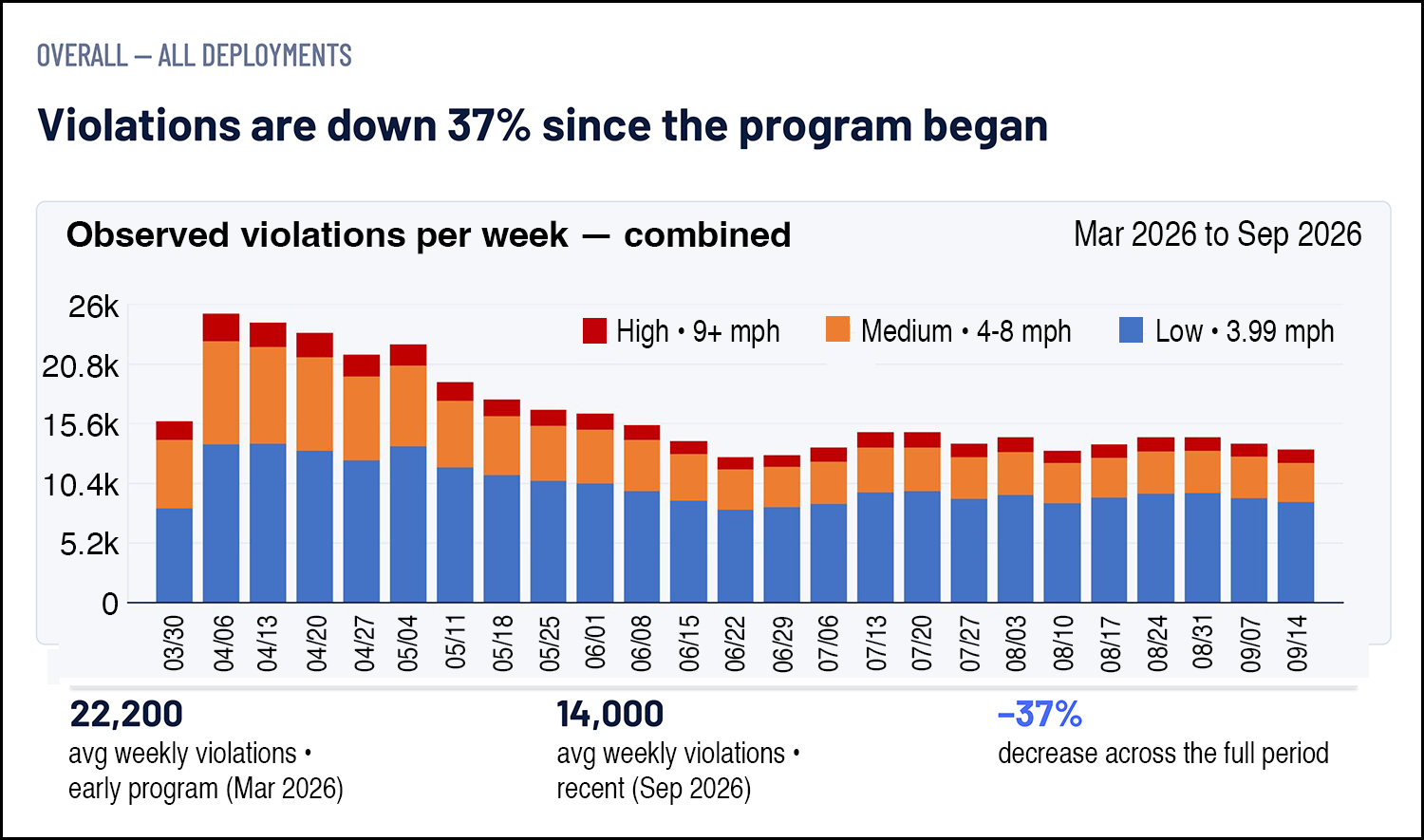
Stop sign violations have dropped by 37 percent since Greenbelt installed cameras at six specific locations in the city in March. The city has not yet broken even on the program, Police Chief Richard Bowers told the News Review this month.
Three months of data from the program show weekly violations have dropped from around 22,000 to 14,000 between early April and mid-September, Bowers said. These violation numbers include all who do not stop, including those going 1 to 3 miles per hour, who are not ticketed. This non-ticketed buffer is meant to encourage safer driving rather than create revenue, Bowers said. Drivers going 4 mph or more through the stop signs are cited; those over 9 mph are considered high-level violations. All citations are issued a $40 fine, regardless of speed.
Bowers believes the encouragement of safer driving is working, as shown by the reduction in violations and changes in driving behavior around the city. “Looking at the reduction in violations, even just driving around the city, if you spend a lot of time driving the streets here, you will see people drive differently,” Bowers said.
Locations
Bowers said the cameras are located in pedestrian-heavy areas. Five of the six cameras installed showed a decrease in violations: Southway at Ridge Road, Ridge Road at Gardenway, Ridge Road at Laurel Hill Road, Springhill Drive at Edmonston Road and Springhill Drive at Cherrywood Lane. Springhill Drive at Cherrywood Lane violations dropped sharply by 72 percent. The remaining camera at Cherrywood Lane at Breezewood Drive showed an increase of 45 percent in tickets. Bowers speculated that the increase in ticketing at that location could be due to initially low numbers related to difficulty tracking the wider two-lane roadway there, noting the camera had recent hardware and software modifications to cover both lanes.
Who Receives Tickets
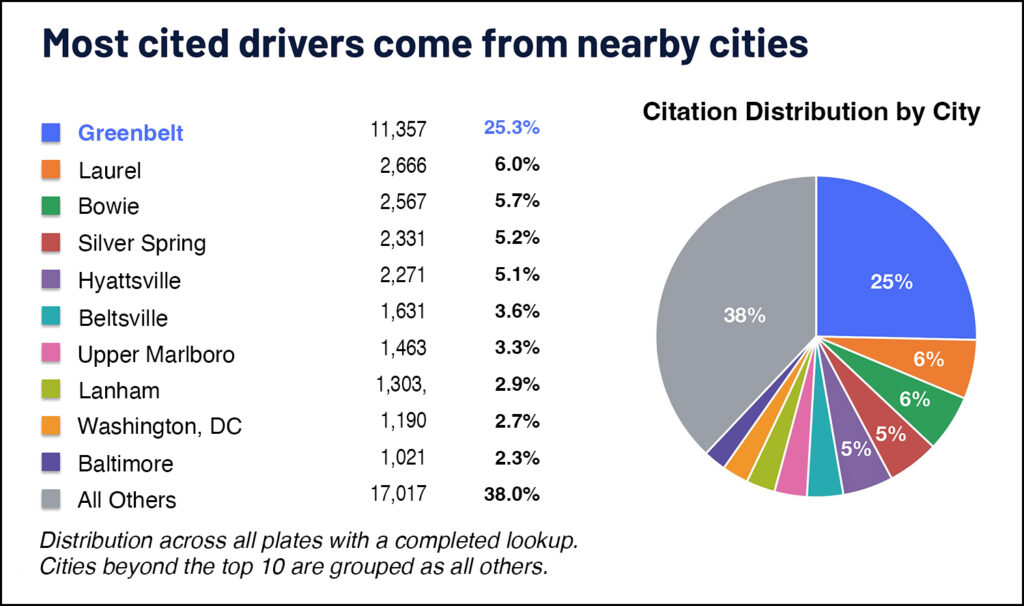
Most violations come from non-Greenbelt residents, who make up 74.7 percent of citations and come from surrounding areas like Bowie and Laurel, Bowers said. Greenbelt residents made up 35.2 percent of citations at the start of April, and that share has since fallen to 20.4 percent for September, for an overall 25.3 percent during the entire period. More than 40 percent of citations sent to Greenbelt residents are issued from the Laurel Hill Road and Gardenway stops.
Yet, 21 percent of cited license plates account for 56 percent of all violations, showing that a small group of drivers are a large portion of the problem, while 79 percent of violators are cited only once. To keep drivers from receiving several citations at once, Greenbelt implemented a 14-day grace period, meaning a driver should receive only one citation in the mail before another is issued.
While Fridays have the most citations, weekday violations peak at 5 p.m. and weekend violations peak at noon.
Ticket Revenue
The city has not broken even with the program. If the income from citations does not cover operating costs, the city does not owe the vendor the difference because the program is designed to be revenue neutral, Bowers said.
According to the August report, at the end of April the city had a deficit of $15,365 from running the program. This included $9,365 for 1,873 warning letters, for which the city paid $5 each, and $6,000 in monthly camera fees. The total stood at $79,500 at the end of May, and was down to $52,519 at the end of August.
“There’s still an outstanding balance that we owe to Obvio,” Bowers said, referring to the company the city contracted for the program. “It gets whittled down a little bit every month, but the way that the contract is set up, essentially we split [revenue] until that balance is paid off. We’re only getting a payment rate of about 45 percent, so that’s why the income is only just short of barely covering the program costs.”
According to the August report, the city collected $645,760 through August from 16,144 paid citations. $329,337 of that went to the city, and $316,422 went to Obvio. The program costs a total of $368,941, while the remaining balance owed to Obvio is $52,519. However, most citations are going unpaid. Only around 45% of citations are being paid, Bowers said. If a resident doesn’t pay their traffic citations, including stop sign camera violations, they will be unable to renew their vehicle registration with the MVA, said Bowers.
Greenbelters’ Reactions
Residents have been vocal on social media about not knowing how long they need to stop, or how far or close to the line they need to be.
Bowers said drivers do not have to stop for a set amount of time or a specific distance from the line; their vehicle just needs to come to a complete stop. While the system has leeway with the 1 to 3 mph buffer, Bowers said they still encourage drivers to come to a complete stop. “If you really watch your speedometer and get to 3 mph, you basically have to stop,” he said.
There were mixed reactions to the cameras being installed, said Bowers. “I think a lot of residents find positives in it, and maybe an equal number of residents think it’s unnecessary.”
“It’s about time people drive safe. If this makes people start paying attention to do the right thing, great,” Michael Richards said in a Facebook comment. “This is unwelcome surveillance and a cash grab. Please remove,” said Tristan Epp Schmidt in another Facebook comment. On the same page, Julie Gillern weighed in, saying, “Stop means stop! And a win for the rest of us!”
Bowers said the city is considering safety awareness and targeted education, which it has done through its Facebook page along with enforcement targeted at peak violation times.
Claudia Stuart is a University of Maryland student at the Philip Merrill College of Journalism interning with the Greenbelt News Review.