This is the first of a two-part series of articles looking at the absence of specimen ballots in Greenbelt in time for the primary election on June 23. This article considers the importance of the specimen ballots and the impact of their absence. A second article investigates what went wrong with the delayed mailing.
When the News Review asked readers to share when they received their specimen ballot and voter guide in the recent primary election, the response was overwhelming — a day or two after the June 23 election, said the vast majority.
What the Law Required
Maryland Election Law 8-102 states that specimen ballots must be mailed at least one week before the first day of an early voting period. Early voting in Prince George’s County began June 11, so the deadline for mailing specimen ballots should have been June 4 at the latest. Instead, according to a June 12 announcement from the Prince George’s County Board of Elections, processing and shipping began in waves on June 10, just one day before early voting began and six days after the legal deadline.
However, the majority of ballots were mailed even later, on June 19, over two weeks after the required deadline. In addition, though the statute specifies a specimen ballot be mailed to all eligible voters, the mailing went only to in-person voters, not those who requested mail-in ballots.
Why Specimen Ballots Matter
The specimen ballots contain information about the upcoming election, when it is, where to vote and the candidates in every race, of which there were many. In Prince George’s County, a staunchly Democratic county, the primary, in effect, is the deciding election for many positions, including county council seats.
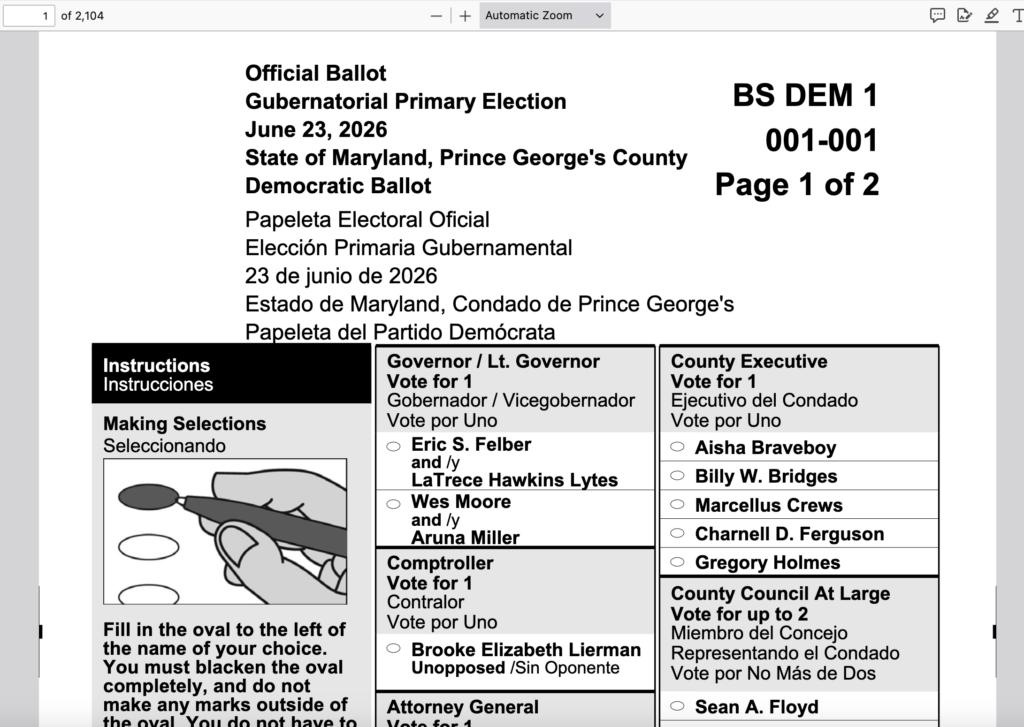
A copy of an official ballot was available online but included all races for the county, from which residents needed to find which applied to them within the 2,104 page document.
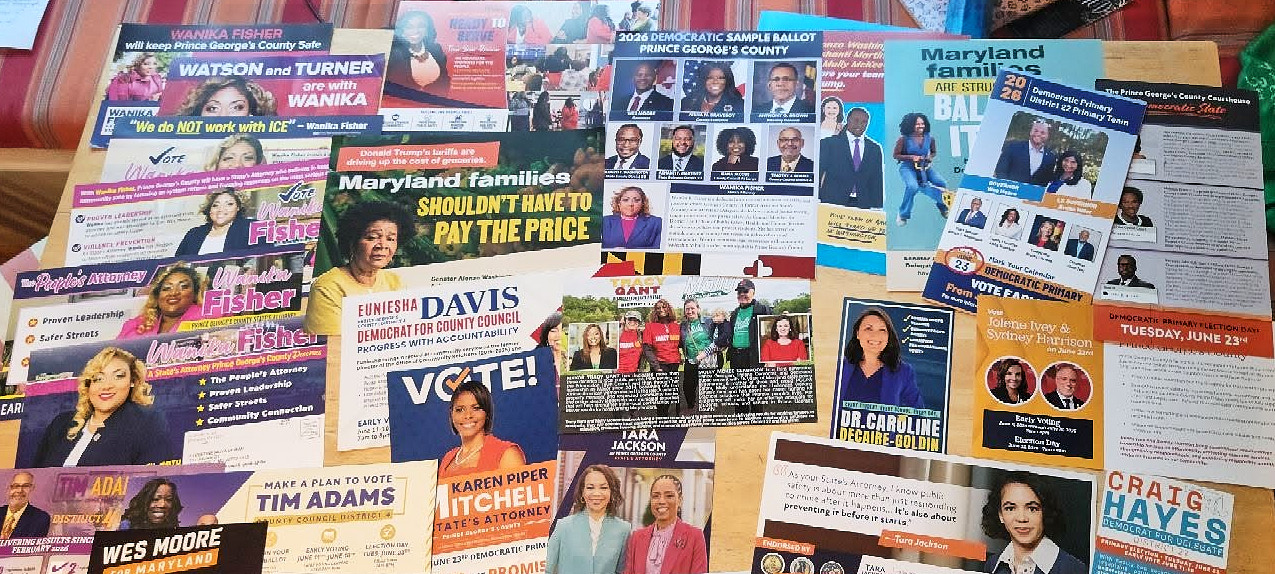
Meanwhile, so-called sample ballots prepared by campaigns, with select information about who was running and suggested slates to vote for, were sent to households in abundance. Without impartial, official information, incumbents and the best-funded candidates had an advantage.
Craig Hayes, a Democratic candidate for Maryland House of Delegates, District 22, told the News Review that voters were clearly less informed than usual for this primary election. “It became apparent around the beginning of early voting that more voters were less informed than usual. Voter confusion was a defining theme in our team’s outreach notes from door knocking, phone calls and texts,” Hayes told the News Review.
Greenbelt resident Angela
Oddone expressed concern about the impact on lesser known or unknown candidates. “Nobody knew anything about the people who were publicly funded,” she told the News Review. “They didn’t have the name or the facial recognition. There’s only so much canvassing they can do. It’s a big county.” Oddone lamented that a lot of people are uninformed, suggesting that some residents just trying to keep their head above water aren’t able to look up candidates and didn’t even know who to look up. Many people don’t have local news any longer, Oddone noted. “We’re very lucky [in Greenbelt] to have local, independent news.” Oddone believes there needs to be an investigation.
“The specimen ballot delay absolutely affected all of our campaigns’ abilities to communicate effectively with voters,” said Hayes. “In our siloed information environment, people still rely on mail for official communication from their government, and many voters use the specimen ballot to research candidates and ballot questions before making their decisions.”
“Mailers are expensive, people are reluctant to answer their phones and door knocking is physically demanding and time-consuming. These dynamics favor slates, incumbents, establishment-backed and corporate-backed candidates who can fill (or have SuperPACs fill) people’s mailboxes and bombard us with ads,” noted Hayes.
Jeana Jacobs, who was in a tight race for a County Council At-Large position, agreed. “Errors as significant as what was experienced this election cycle created confusion for voters such that it could lead one reasonably to wonder about the election results of a county-wide candidacy such as mine when the difference between me and the candidate who officially won was 0.33 percent or 730 votes,” Jacobs told the News Review. In that race, Sydney Harrison, a term-limited outgoing councilmember for District 9, with name recognition after eight years on council, won an at-large seat with just 0.33 percent more of the vote than Jacobs. “Listen, elections are won and lost, I get that and I will serve nonetheless, but voters must be able to trust that their vote matters and that the process is tried and tested to protect the integrity of the election process,” said Jacobs.
Voter Turnout Numbers
The Board of Elections’ FY 26 Proposed Operating Budget projected 250,000 voters in the primary, nearly twice as many as actually cast accepted ballots.
This primary had 129,060 accepted ballots, representing 24.54 percent of eligible voters. Total votes cast were 132,673 (which would suggest voter turnout at 25.23 percent), but over 10,000 of those were provisional ballots, of which over 30 percent were ultimately rejected, according to the Maryland State Board of Elections. The number of provisional ballots cast in Prince George’s County during the primary — 10,258 — was the highest in at least three election cycles, despite lower overall turnout than both the 2024 presidential primary (6,922 provisional ballots) and the 2022 gubernatorial primary (8,703 provisional ballots.)
The News Review asked the county’s Elections Administrator Wendy Honesty-Bey, Board of Elections President Beatrice Tignor and Board Counsel Arthur Horne, as well as several candidates in the recent election, if they believed the Board of Elections’ failure to meet the statutory mailing deadline had any effect on voter participation or the outcome of races in this primary.
“No, the Board does not believe this was a contributing factor to actual turnouts,” Honesty-Bey told the News Review.
Jacobs thought otherwise. “Mistakes happen but sending wrong ballots, sending [specimen] ballots late, all contributes to voter despair and likely low turnout,” Jacobs told the News Review. Hayes said, “Just looking at voter turnout numbers, you can tell voter participation was affected.” Hayes told the News Review that the mistake with the mail-in ballots from the State Board of Elections further complicated the situation. “I spoke with voters in the three days leading up to June 23 who still had not received their second replacement mail-in ballot and were unsure if they could vote on Election Day instead, unaware of the provisional ballot rules,” says Hayes. “By extension, the decreased turnout may have affected the outcome of races in this primary by benefiting incumbent and establishment-backed candidates over challenger and insurgent candidates. With the absence of specimen ballots, candidate-sponsored ‘official’ sample ballots were especially abundant this year and readily filled that vacuum of information. Of course, many of those ‘official’ sample ballots excluded non-preferred candidates,” Hayes told the News Review.
At a meeting of the Prince George’s County House Delegation and the County Board of Elections on Monday, August 3, Delegate Deni Taveras said she would attribute low voter turnout in her district, 47B, to not receiving specimen ballots until after the election. “People in my district feel highly disenfranchised with what occurred in this particular election,” said Taveras.
No Alternative Invoked
According to the statute, a board of elections that does not mail specimen ballots to registered voters at least a week before early voting “shall give notice of the election by newspaper publication or other means of mass communication.” However, the Prince George’s County Board of Elections did not invoke the alternative-notice provision under Maryland Election Law as a substitute for or supplement to the physical mailing. “Although the Board runs election ads across multiple radio stations, radio advertising cannot serve as an alternative notice because it lacks the full, legally required components of a specimen ballot,” Honesty-Bey told the News Review.
On Monday, Delegate Nicole Williams pressed the board on why they didn’t invoke a substitute when they knew the specimen ballots were going to be late. Honesty-Bey replied that there was so much on the ballot she didn’t believe it could be done by mass media or radio ad. “Is there a contingency plan in place with the local board … if it appears that the sample ballot is going to go out late?” asked Williams. “In the election law article it also allows for the local board to distribute by publication or dissemination by mass communication during the calendar week preceding the election. So, my question is, is there a contingency in place that meets the requirements of 8-102 A2 of the election law article code for that mass communication?” said Williams. “No,” responded Honesty-Bey.