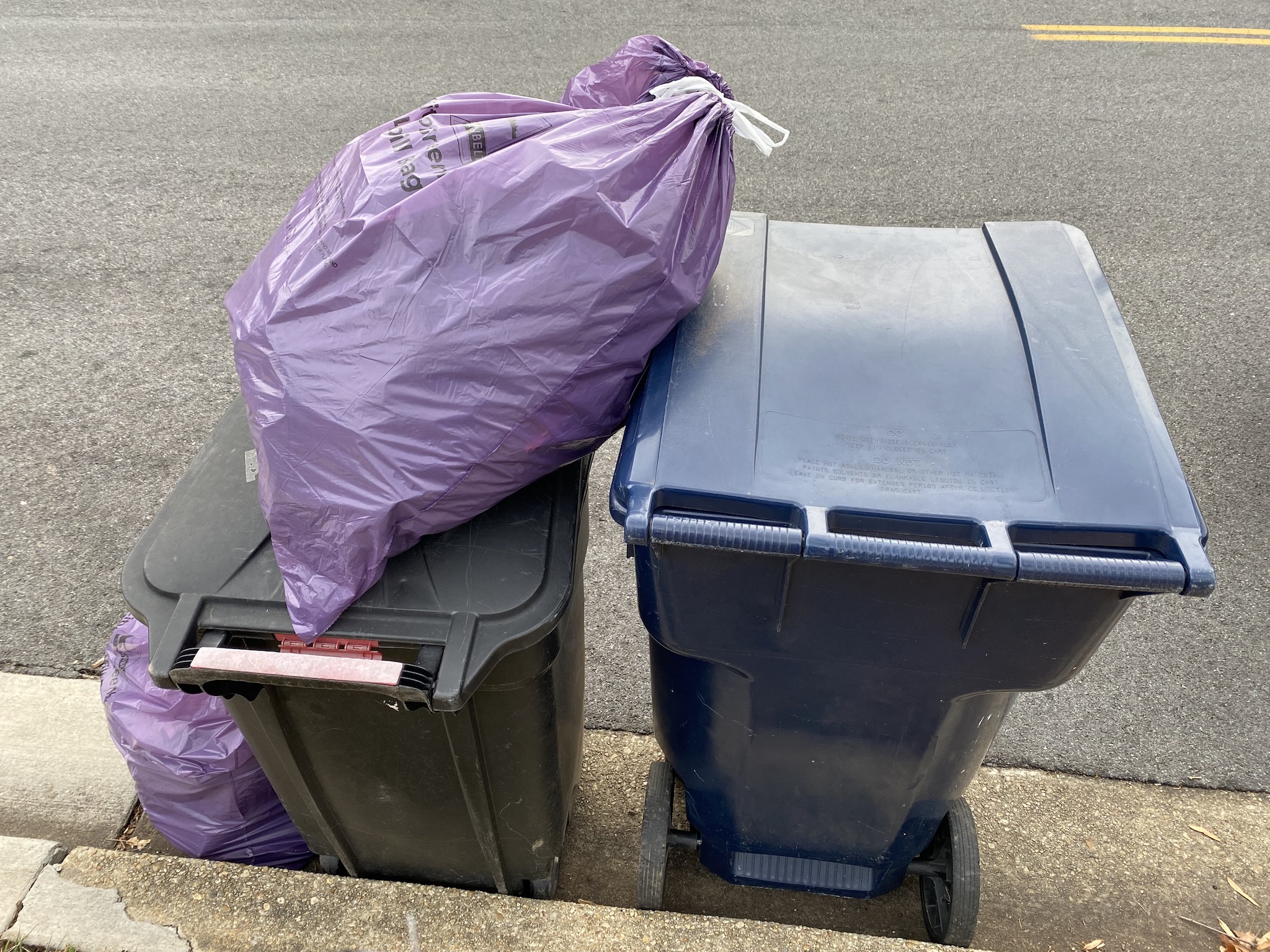
Greenbelt’s new Save As You Throw trash program is beginning to reduce waste, with residents saying it has changed how they manage household trash.
Early data show about 72 percent of households are using the pay-per-bag system, while 28 percent opted for the flat-rate Max Trash option, according to Sustainability Coordinator Luisa Robles. The city has also seen roughly a 16 percent reduction in waste so far.
The program, launched in
January, charges residents a base fee and then ties additional costs to how much trash they produce. Households can either buy special city bags or pay for a Max Trash sticker that allows up to three large bags (equivalent volume 99 gallons) of trash per week.
Resident Experiences
For some residents, particularly those in smaller households, the change has led to lower costs and less trash. Deborah Kijak Hess, who lives alone, said she chose the Save As You Throw option after reviewing the pricing.
“I’m in a one-person household, so when I looked at the cost analysis, Save As You Throw appeared that it was going to be a lot cheaper,” she said. “And that’s turning out to be the case.”
Hess said the program also changed how she manages waste. Instead of putting out a bag every week, she now waits until it is full, reducing how often she sets trash out. “I don’t throw out nearly as much trash as I thought I did,” she said.
She said the program, which she initially thought would be complicated, has been easier than expected and works well for her neighborhood, which is made up mostly of one- and two-person households.
Evelyn Reisenwitz, who lives with her spouse and young child, chose the Max Trash option, citing the volume of waste from diapers and a preference for a simpler system. “I didn’t want to have to think about what bags I was using,” she said, adding that her household may reconsider once their child is older.
Reisenwitz said her own experience with the rollout was smooth, but she was concerned by confusion among other residents. “I think that my biggest concern is that folks were not open to the program because they did not understand the program,” she said. She added that the city could have done more early on to clarify how the system would affect different households and what changes would be required.
Despite those concerns, Reisenwitz said she supports the program’s overall goals. After initially feeling skeptical, she said the approach made more sense as she learned more about it and considered the alternative of raising costs for all households.
Reisenwitz said changes to trash collection, such as new requirements for placing cans outside GHI trash enclosures and closets, were a bigger adjustment than the pricing itself. Needing to remove trash cans from closets and enclosures created challenges for some households, particularly those with mobility limitations. “I’m sure for some folks, that was actually quite a transition for them,” Reisenwitz said.
Waste Reduction Goal
City officials have said the program is intended to encourage residents to reduce waste and delay reaching capacity in existing landfills. The alternative would have been raising flat fees for all households, regardless of how much trash they produce.
Reisenwitz said that while the rollout was difficult for some, the program appears to be stabilizing after its first few months. “I think the toughest part of the program was the rollout,” she said. “Change is hard.”
Hess said she hopes the program continues, pointing to the reduction in waste and its potential to encourage recycling and composting. “I will not be a happy camper if we end up having to go back to the way we were,” she said.
City officials said more data will be analyzed in coming months as they evaluate whether the program is meeting its long-term goals. Further financial details will be shared at a city council budget worksession on Public Works scheduled for Wednesday, April 15.
Stephen Lotz is a University of Maryland student at the Philip Merrill College of Journalism interning with the Greenbelt News Review.