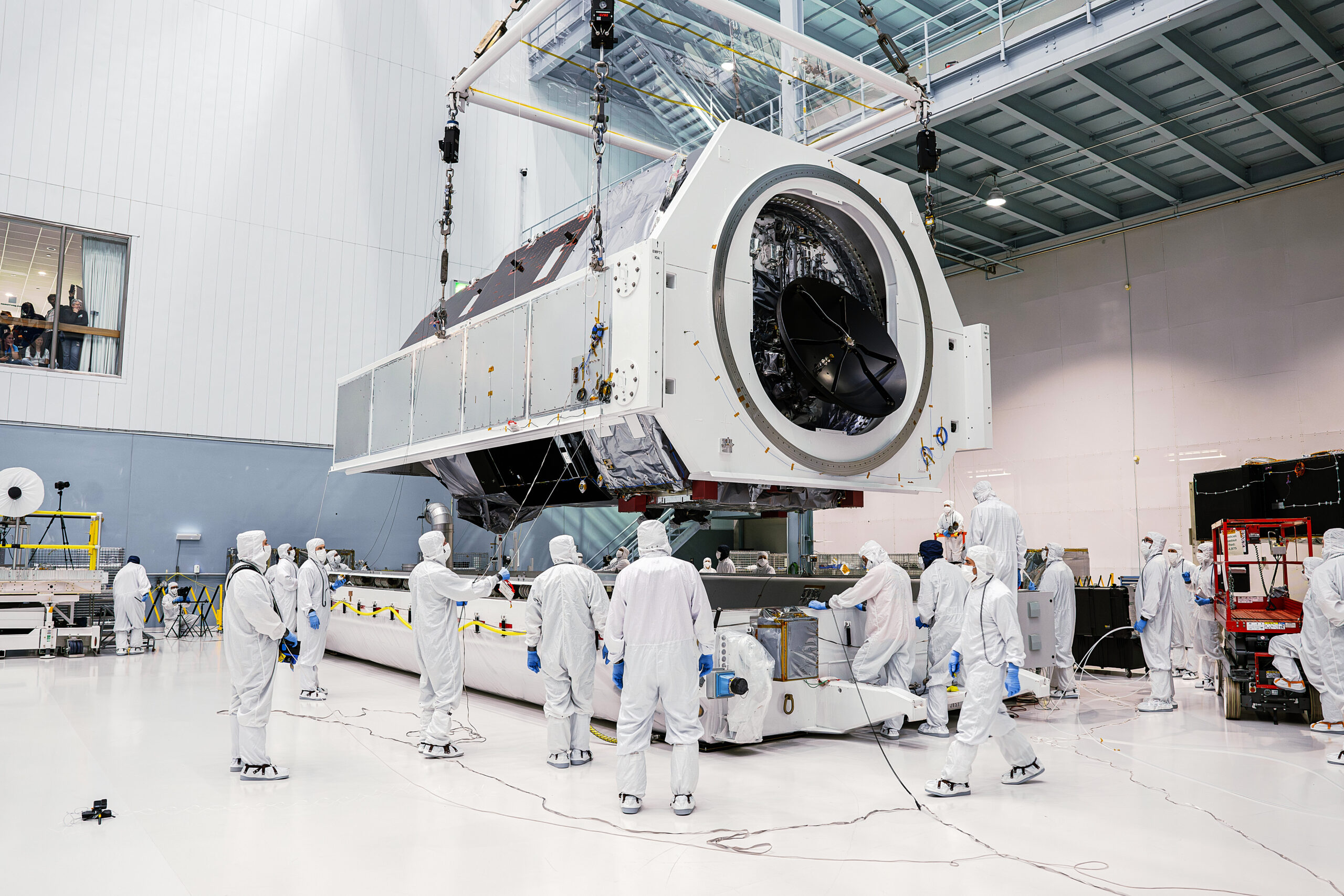
If all goes well, a not so little piece of Greenbelt will be launched into space on Sunday.
The Roman telescope, built at Goddard Space Flight Center (GSFC) will launch from Kennedy Space Center after a June nighttime journey by boat from Baltimore to Florida. GSFC personnel coordinated the work of many partners across the U.S. and around the world and completed the project under budget nine months early.
Nancy Grace Roman was a NASA employee from the agency’s inception and was the first Chief of Astronomy. After leaving her job at NASA headquarters in downtown Washington, D.C., she worked at Goddard with many Greenbelters.
Shawn Domagal-Goldman, director, Astrophysics Division at NASA headquarters, said NASA missions “set out to do the impossible and achieve it. The Roman mission will be no different. In previous missions we found out how to locate asteroids that might be a threat to Earth.” Some other impossible achievements became routine parts of daily life, such as medical imaging and cellphones, he said.
The mission includes three phases: launch, commissioning and science research.
The Numbers
The numbers for this mission are, well, astronomical. The science phase will begin once Roman reaches Sun Earth Lagrange point 2, about a million miles away from earth, where the sun’s and earth’s gravity balance out. It will take Roman 90 days to get there.
Jeremy Perkins, Roman telescope integration and test scientist, said, “Once we begin the science operations Roman will transmit one terabyte of data per day, the equivalent of streaming a million songs.”
Roman will explore two billion galaxies.
Roman’s field of vision is at least 100 times larger than that of the Hubble telescope.
The exploration of the Milky Way, which will take Roman one month, would take Hubble a century.
There are hundreds of people on the operations team, but with thousands able to look at the data instantly the number of people working on the mission “is almost uncountable,” Perkins said.
The Commissioning
Jackie Townsend, Roman telescope project manager, said after the launch there will be 100 days of commissioning, preparing the observatory to conduct the science work. To prepare for that there have been 50 mission readiness tests taking 1,100 hours on the ground.
Perkins said “we’ve been practicing over and over and over, and the commissioning phase will make sure the telescope is operating like we know it can.”
The Science
Everyone from high school students to professors, and anyone else interested, will have instant access to the data from Roman.
Going into space allows Roman and other telescopes to work free from the interference of the Earth’s atmosphere.
Every NASA mission answers some questions and raises others. Some of the questions Roman has been designed to explore came out of the data produced by the Webb and Hubble telescopes.
Julie McEnery, Roman telescope senior project scientist, said, “We have worked with scientists for years to get their ideas for use of this telescope. We put together three large surveys and many other projects. … Regardless of where your scientific interests lie there will be a data supply of use to you.”
Roman’s first five years will include, among other things, three broad surveys studying dark energy, exoplanets (planets outside our solar system) and infrared astrophysics. With an expectation that Roman will last at least 10 years, what is researched in the second five years will depend on what it finds in the first five.
Roman’s work on exoplanets will get us closer to one of the big cosmological questions: are we alone in the universe? Tools in the observatory will cancel out bright starlight so planets around a star are visible.
A broad question the Roman telescope will examine is our understanding of how the universe works. There have been “hints over the last five to 10 years that all is not well with our standard model of the universe. Roman can show us how the universe really works,” McEnery said.
This is why science is never settled, new information leads to new understanding. Some models get tweaked, others have to be rebuilt from the ground up.
Roman will continue to work with other telescopes, both in space and on the ground. If Hubble or Webb find something strange Roman can follow up, McEnery said. The ground-based Vera Rubin telescope, in Chile, was designed to work with Roman, to combine observations. Roman can clarify for Rubin what it is seeing.
The Legacy
Perkins said, “The data set from Roman will produce a legacy that will benefit all mankind, not just now but for five, 10, 20 years.”
“I hope a student sitting in a classroom now will look at the data and catch the science bug, be the next Nancy Grace Roman,” said Townsend.
Roman’s vast reach “will allow us to find the weird, the rare and the unusual,” according to McEnery. “The most exciting things will be a surprise, something we couldn’t predict.”
Launch Details
Launch is Sunday, August 30 at 7:26 a.m. EDT
To watch the launch on NASA’s website
plus.nasa.gov/scheduled-video/nancy-grace-roman-space-telescope-launch/
Coverage begins at 6:20 a.m.
On-demand streaming video and launch photos will be available shortly after liftoff.
Follow mission updates on https://science.nasa.gov/blogs/roman/
Watch and engage on social media
Let people know you’re watching the mission on X, Facebook and Instagram by following and tagging these accounts:
X: @NASARoman, @NASAUniverse, @NASAKennedy
Facebook: @NASARoman, @NASAGoddard, @NASAKennedy
Instagram: @NASAGoddard, @NASAUniverse, @NASAKennedy
Virtual Launch
Register for the virtual launch at https://www.eventbrite.com/e/nasas-nancy-grace-roman-space-telescope-launch-tickets-1983457247019?aff=oddtdtcreator
Virtual guests for this launch will receive curated mission resources, stay informed with the latest update, and more — all delivered straight to their inbox.
Audio-only coverage
Audio-only coverage of the launch will be carried on the NASA “V” circuits, accessible by dialing 321-867-1220 or 321-867-1240. On launch day, mission audio countdown activities without NASA broadcast commentary will be carried on 321-867-7135.
More information on Roman, the woman, the telescope and the mission can be found at nasa.gov/roman