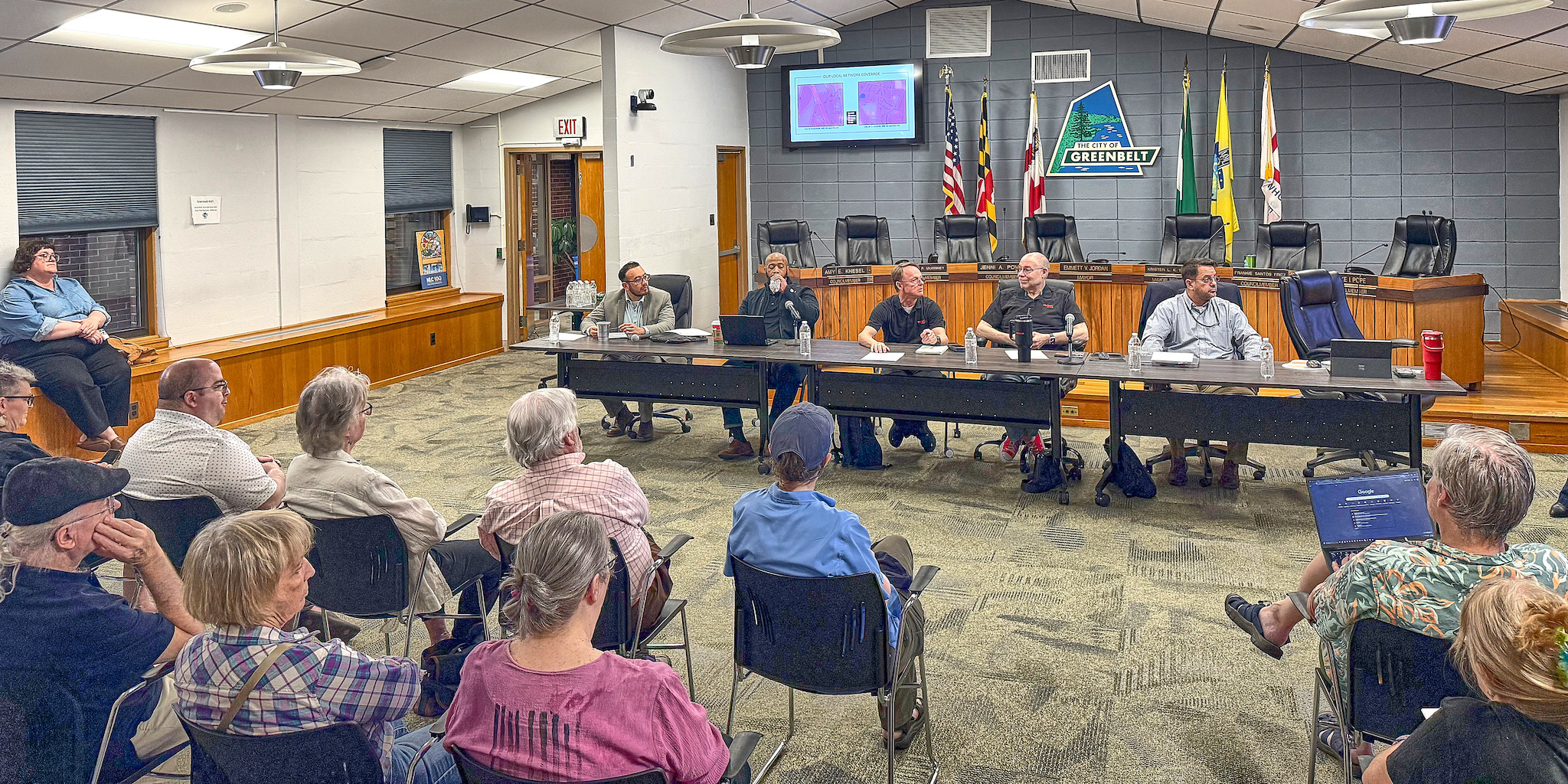
On Tuesday, March 10, frustrated residents pressed wireless carriers and city officials for answers about persistent cellular coverage problems during a meeting focused on improving service across Greenbelt, particularly in the Ridge Road and Plateau Place areas where many residents say signals are unreliable.
Representatives from T-Mobile and Verizon met with roughly 30 residents and city staff to explain how cellular networks function, what may be causing service gaps and what potential fixes could look like in the short- and long-term. While some adjustments may be possible in the coming months, carrier representatives said building new infrastructure to address coverage gaps can take one to two years. “We have dedicated teams that look at network performance,” the Verizon representative said during the meeting. “If we have to build a new site, then we’re talking a year to two years.” The Verizon representative requested he not be named.
The Problems
Residents described frequent dropped calls and weak signals throughout parts of the city, particularly in the Ridge Road corridor and near the city center. Several residents said the coverage gaps affect everyday communication and can create anxiety during emergencies.
Councilmember Frankie Fritz said they have experienced the issue firsthand and worry it could affect teleworkers and visitors who rely on mobile service. “I’m better off waiting outside the city or waiting outside the city center, finishing my call in a Safeway parking lot, then driving home.” Fritz also mentioned that it could discourage people from moving to Greenbelt.
Cellular Coverage
City officials said the meeting was intended to help identify both immediate steps and longer-term solutions to the coverage issues. Carriers explained that cellular coverage relies on a combination of frequencies across low, mid and high radio spectrum bands. Lower frequencies travel farther and penetrate buildings more effectively but carry less data, while higher frequencies can deliver faster speeds but cover smaller areas. “By combining all three, we kind of give you the best experience,” said Sharrad Hayes, a representative for T-Mobile.
Coverage can also be affected by terrain, building density and the distance between antennas. Carriers said some residents may experience weaker signals if their phones do not support newer network bands. “If your device doesn’t support it, you’re missing 60 percent of our network resources,” the Verizon representative said.
Short-term Fixes
Carriers said they will share more detailed radio frequency maps with city officials to better identify coverage gaps. In the short term, they recommended steps such as enabling wi-fi calling, installing signal extenders or upgrading phones that cannot access newer network bands.
During the meeting, Verizon representatives displayed a map showing coverage strength across the city. North and south Greenbelt consisted mostly of “fair” coverage, the lowest of the three tiers. Areas along 495 were largely “best” coverage, the highest tier, while historic Greenbelt was mainly “good” coverage, the middle tier.
Engineers will conduct field testing in areas where residents have reported poor service. If adjustments such as antenna changes do not resolve the problem, additional infrastructure may be required. Improving coverage often begins by identifying a “search ring,” or geographic zone where signal performance is weakest. Carriers then look for property owners willing to host equipment and determine whether smaller installations can solve the problem or whether a new site is needed.
Alternatives
If a new tower or antenna site is required, the process can take up to two years because of regulatory approvals, lease negotiations and community input, according to carriers.
City officials said they would prefer to use existing public facilities before constructing new towers. Potential options include installing antennas on city buildings, placing small cell equipment on utility poles or hosting infrastructure on city-owned land such as Northway Fields.
However, officials said the city currently lacks much of the infrastructure typically used to support telecommunications equipment. “There are some real infrastructure challenges. We don’t have any infrastructure that is needed for setting up telecom, power poles, the towers,” City Manager Josué Salmerón said.
Officials also discussed the possibility of building a shared tower on city property if other solutions fail. “We own [Northway Fields]. So, when the question came up at the council worksession, what are the options? How do we build a tower here and invite all the carriers?” asked Salmerón.
Officials acknowledged that new infrastructure proposals can generate community concerns about aesthetics or location. Residents also emphasized the importance of reliable service during emergencies, particularly if power outages or internet disruptions prevent the use of wi-fi calling. Carriers said emergency calls connect through whichever signal is strongest at the moment, regardless of the user’s network. “When you dial 911, you will connect to 911,” the Verizon representative said. “Your call is going to connect on whatever signal is strongest.”
Report Poor Service
City officials encouraged residents experiencing poor service to provide their addresses and device information so the reports can be forwarded to carriers for investigation. Officials said gathering detailed information from residents will help the city coordinate with carriers and track problem areas. “We need to make sure that we know the information that we want to collect and then figure out a mechanism to collect it and collate it,” Councilmember Kristen Weaver said. “This will be an ongoing thing.”
“Your advocacy is helping us advocate for you,” the Verizon representative told residents. “So, thank you so much for this.”
City staff said they will continue working with carriers and residents to monitor coverage issues and share updates as potential improvements are identified. Residents can also report problems directly to their carriers. Verizon customers can dial *611 from their mobile phones or call 1-800-922-0204 to report outages or coverage gaps, while T-Mobile customers can dial 611 to report dropped calls or weak signals.
AT&T representatives did not attend the meeting.
Stephen Lotz is a University of Maryland Student at the Philip Merrill College of Journalism interning with the Greenbelt News Review.