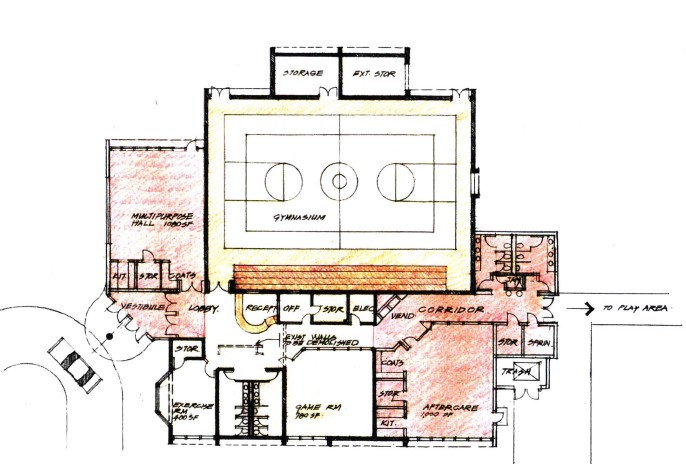
Plans for Springhill Lake Recreation Center’s (SLRC) expansion began over 20 years ago. Now, recent federal funding may make it a more imminent reality.
Greenbelt received over $1.8 million in federal funding, which included $250,000 for SLRC expansion and approximately $1.5 million for the Youth Center roof replacement (see the March 12 issue). “These facilities answer the critical need to provide youth gathering places, meet quality child-care needs and support after-school and summer programs,” said City Manager Josué Salmerón.
Long-awaited Expansion
The $250,000 in federal money will support the design and engineering work for the proposed addition to SLRC. Plans for the addition and renovation date back to at least 2002, when then-City Manager Michael McLaughlin worked with Laurel Design Alliance on plans for its redesign and expansion.
Priorities
The federal funding for SLRC and Youth Center renovations awarded to Greenbelt comes at a time of great need, but further funding is needed to remedy other dire challenges, say area residents in Franklin Park, where SLRC is located.
While the investment is a major step forward for city facilities, some community members and volunteers voiced concerns about how funds are divided across the city – SLRC is located in the Franklin Park neighborhood and the Youth Center in the city center – and whether they address the most immediate needs. The city received approximately 30 percent of its requested amount for SLRC and all of the requested amount for the Youth Center. Several residents point to ongoing needs and longstanding maintenance issues at SLRC, despite the city’s record of delivering improvements and fixes when residents made requests.
For Kevin Lockhart, also known as Coach K., a longtime volunteer at SLRC, the issue is not whether Greenbelt invests in its facilities but how those investments are prioritized.
“I am a volunteer, facilitator, advocate, mentor. I do a lot of things here,” Lockhart said.
He emphasized that the city has historically responded when the community raises concerns. “When we need something, they’ve given it to us,” he said. “They did a fantastic job of doing and giving us what we needed.” He cited past improvements, including upgrades to the playground and gym, as evidence that the city follows through. “We got a huge, nice playground back there and a nice outdoor basketball court. I mean, we needed it and they gave it to us,” he said. Though Greenbelt has a track record of responding to community needs, residents want more proactive and balanced investment, especially when large-scale funding becomes available.
Allocation of Funds
Lockhart questioned the allocation of the latest federal funding, arguing that more immediate facility issues remain unresolved. The award specifies the amount to each project but Lockhart would have liked to see it split evenly. “We need our heating system and our air conditioning system fixed,” he said of SLRC. Recurring mechanical failures affect daily operations, particularly in extreme weather. While repairs are routinely made, the cycle continues without a long-term solution, says Lockhart.
“It breaks down every two weeks, every three weeks, every month or whatever,” Lockhart said. “How many times are we gonna let something break and fix it and break and fix it and break and fix it?”
Carolyn Lambright-Davis, a 14-year Greenbelt resident, community volunteer and Chesapeake Education, Arts and Research Society (CHEARS) board member, echoed both appreciation for the funding and concern about how it is distributed.
Lambright-Davis framed the issue as one of fairness across different parts of the city. While acknowledging that improvements have been made and city staff respond to issues, she said the facility still requires significant upgrades.
“Public Works is phenomenal but it [SLRC] needs to be renovated for our children,” she said.
Like Lockhart, she pointed to ongoing maintenance problems, including heating, structural wear and limited space for programming.
Funding the Expansion
The city is looking to other sources to fully fund the project. That includes working with the county and state to reallocate $1.5 million in Program Open Space (POS) funding that had previously been earmarked for the Youth Center roof project. “The city’s intent is to use that funding toward construction of the SLRC project, subject to the required county and state approval,” Salmerón told the News Review.
“Potential funding sources for the project include federal funding, POS funding, county and state support, potential support from Park and Planning, and local city funds,” said Salmerón.
Critical Resource
Lockhart stressed that despite challenges, programming at SLRC remains active and impactful. “For a center that has very little, we give a lot,” he said.
It operates as a hub for youth services, education and community support for Franklin Park. Lockhart described SLRC as a critical resource for local families. “This is a very busy center,” he said. “The gym is active seven days a week.”
Programs include tutoring, athletics and after-school care, often serving children who rely on the center as a safe and supportive environment. At the press conference to celebrate the funding, Brian Butler, SLRC recreation coordinator, said the center is a safe place where children can go after school and be fed, physically and mentally. “It says something when a parent can come home and relax and know that their child is at a community center which is a safe zone. We have homework time. We do provide lunches, and they’re here with counselors who care. We have people like the Davises and Coach K who also bring into the community what is missing, I believe, in a lot of places, and that’s the elders’ wisdom,” said Butler.
“They know this is a safe haven for them,” Lockhart said. Lambright-Davis pointed to volunteer-driven initiatives, such as mentoring and environmental education programs, as examples of how the community continues to invest in its youth regardless of facility limitations.
“We all have to do our part,” she said.
SLRC Timeline
The city council has not yet made a final decision on the additions or final site design for SLRC, nor does the city have all the funding it would need to complete the project. Salmerón told the News Review they’ve mostly relied on the prior planning work from 2003, when PRAB/APB reviewed the proposed addition and renovation concept for the facility. However, Salmerón had some reservations about the space design that is now more than two decades old, questioning whether it fully meets today’s programming needs for SLRC and the surrounding community. “The demand for space at Springhill Lake far exceeds the facility’s current capacity,” said Salmerón, who suggested the community may benefit more from one larger, flexible program space than from adding a smaller room and expanding the current game room, as the original plans propose. “Much more work is needed to revisit, evaluate and vet the prior design before final decisions are made,” Salmerón said.
The city does not have a firm timeline for beginning redevelopment or construction of the SLRC addition, said Salmerón, as “the city still needs to determine the final design, evaluate current community and programming needs, and develop a more precise construction cost estimate.” However, he noted, “the acceptance of the federal and POS funds puts pressure on us to move forward with the project, as both sources have timeline requirements.”
Youth Center Timeline
On the other hand, the city does now have the funding it needs to replace the Youth Center roof and expects that project to begin in September. However, Salmerón noted that delays are possible and the schedule will depend on the county permitting and review process.
As Greenbelt moves forward with requesting federal funding, grants and other money, residents and volunteers who spoke with the News Review say the challenge will be balancing long-term development with immediate needs and ensuring that all parts of the community benefit equally.
Laura Charleston is a University of Maryland student at the Philip Merrill College of Journalism writing for the Greenbelt News Review.
Anna Bedford-Dillow contributed to this article.