One prominent item generating much discussion at the April 13 Greenbelt City Council meeting was the response to the Greenbelt Resistance Network’s (GRN) March 2 petition regarding the city’s License Plate Reader Camera (LPR) systems and related policies.
Having submitted 11 questions to council about the cameras with no response, GRN then sent the questions in a petition signed by about 115 people. At the meeting Greenbelt Police Chief Richard Bowers responded.
Christine Wilkin spoke for GRN’s 100+ members, raising concerns about the city’s purchase of 14 LPRs in 2025 for over $175,000. According to Bowers the police department proposed in 2024 to spend about $174,000 for 16 LPRs at 12 sites, with associated infrastructure, which represented less than 10 percent of the city’s cameras.
GRN doesn’t want more cameras in the city, Wilkin said, preferring the money be spent on police officer work.
GRN participant Diana McFadden worried that, in the current political climate, the federal government might access the city’s surveillance data, especially facial recognition, involving the police department in exploitation and political targeting. Bowers answered that neither LPRs, speed, stop-sign nor red-light cameras have facial recognition capabilities.
Purpose and Procedures
LPRs are intended to help prevent and reduce crime, to keep stolen vehicles out of the city and support criminal investigations, Bowers said. In addition to LPRs, the city owns red light cameras on main roads, and speed cameras at numerous sites, especially near the high school, and six stop-sign cameras. 136 security cameras also operate throughout the city.
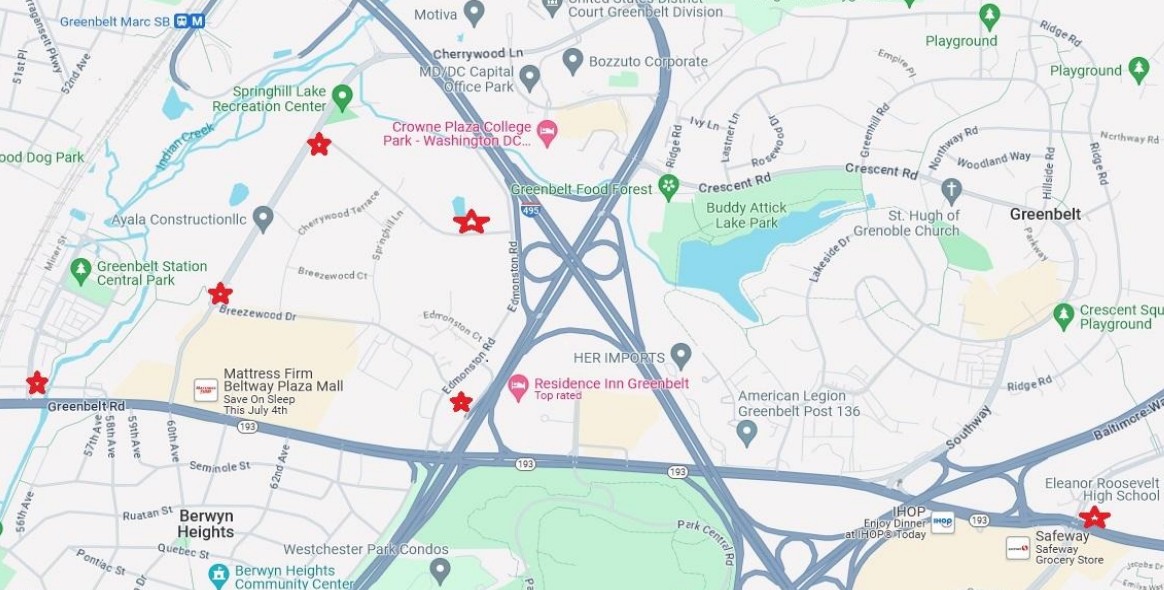
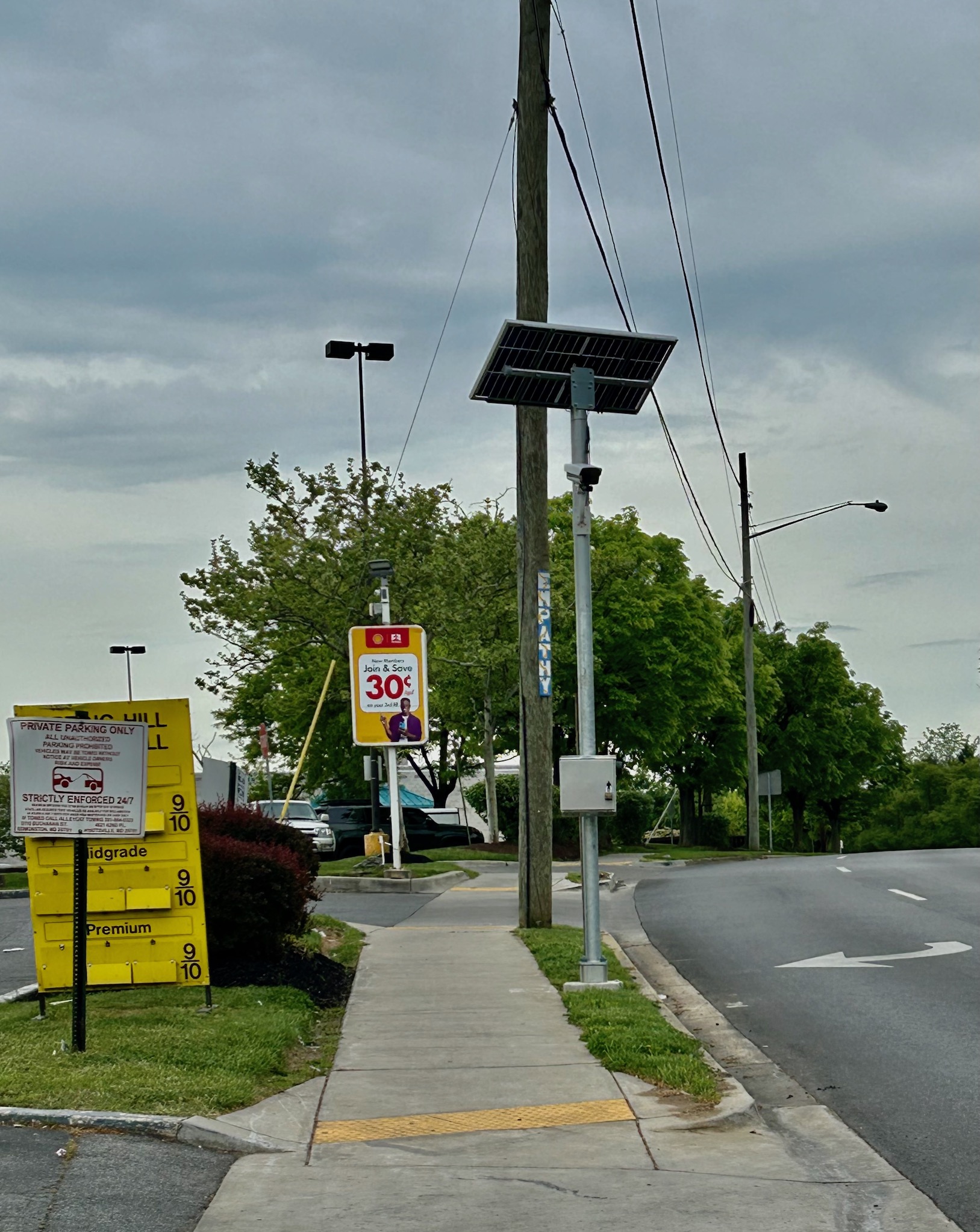
LPRs and “context” cameras are online at six sites with six cameras yet to be installed (see map for proposed locations).
Maryland state law limits use of traffic enforcement camera data to traffic enforcement purposes. If any police department needs the data for another purpose, they must subpoena the vendor, explained Bowers.
The National Crime Information Center maintains a hot list, updated by the state every six hours, against which tag numbers captured by LPRs can be checked. A human must verify a hit.
Data Storage Differences
LPR data is stored within the camera for under 24 hours, then is transferred to the Maryland Coordination and Analysis Center (MCAC). Police have “live-view” capability, but for subsequent investigations they must request the data from MCAC, and such requests are audited and tracked.
Context cameras photograph vehicles and store data for up to 30 days. If full, the camera offloads the data into secure cloud storage. The police own and have sole access to the data, which is deleted after 30 days unless saved in a separate evidence storage system. MCAC guidelines allow other agencies to request data, but access is limited, logged and audited.
No Facial Recognition
The cameras recognize motion inside vehicles but not individual faces. Even that picture is not very clear; technology that might make it clearer is disabled and control is accessible only to high-ranking officers.
Maryland law requires that LPR data be used only for legitimate law enforcement purposes. Installation in a public place doesn’t require a prior warrant and has been found constitutional. Also, vehicle tags are neither personal property nor private.
ACAPS
After council authorized use of LPRs 18 months ago, the Advisory Committee Advancing Public Safety (ACAPS) worked with Greenbelt Police on implementation. Peggy Higgins, ACAPS chair, explained the interaction and addressed GRN’s concerns, recalling that ACAPS had raised similar concerns about data collection, storage, security and use. “Our committee worked to balance Greenbelt’s values of civic engagement and respect for civil rights with the serious safety problem residents are having with car theft.”
With many other cameras already deployed throughout Greenbelt, ACAPS unanimously supported the police general order on LPRs, which included three of their concerns with the fourth left to council oversight.
Usefulness of Cameras
Bowers noted a seasonal uptick in vehicle crime and gave examples of the usefulness of LPR live data, including solving a homicide case, locating a missing elderly person and closing a burglary case.
With money saved from the original $174,000 allotment, police can install additional LPRs in commercial areas subject to vehicle crime, especially at night. These funds would not go far in hiring police officers.
Bowers recommended LPRs for their efficiency, effectiveness and usefulness as part of an officers’ toolkit. He gave assurance that rules are in place to secure data, prevent unauthorized access and prevent sharing with federal immigration, the latter being forbidden by city code.
Councilmember Frankie Fritz asked if Greenbelt shares data with Prince George’s County, which envisions a countywide, centralized database, and Bowers replied that the county can make a request to MCAC to get Greenbelt data.
When Councilmember Kristen Weaver asked which types of cameras are limited to school zones, Bowers explained state law says speed cameras can be placed in residential or school zones, and all Greenbelt speed cameras are in school zones.
Councilmember Amy Knesel voiced opposition to increased surveillance in the city. “There is no data that says LPRs actually reduce violent crime whatsoever. … I’m (also) extremely concerned about continued placement of cameras in primarily rental and minority-majority neighborhoods,” she said.
Councilmember Jenni Pompi asked how stop-sign cameras operate. Bowers said stop-sign cameras record the image of the vehicle passing through and determine its speed. By Greenbelt’s threshold, lower than 4 mph is considered a stop. Violations are sent to officers for review. In the first six days the cameras were operational, they identified 16,000 potential violations (for more on the stop sign cameras see the April 2 issue).
City Manager Josué Salmerón described several city intervention strategies over the last year to encourage stop-sign compliance, saying violations are going down. With city outreach plus fines, violations should drop significantly.
Councilmember Danielle
McKinney asked how placement is determined and Bowers explained that any information-automated enforcement tries to target areas with problems. He said LPR locations are based on crime statistics, repeat offenders and crime patterns by area.
Councilmember Silke Pope asked for assurance that the city is putting only Greenbelt-owned cameras on Greenbelt streets, which Bowers confirmed.
In conclusion Bowers said, “Enforcement is obviously very important when it comes to traffic safety. … I understand we all find these (cameras) annoying, but hopefully we’ll all learn the lesson very quickly and this will not be an issue.”
“Enforcement is one side… Engineering is just as much a problem … a lot of these roads are not under our direct control. These roads are not designed to be pedestrian-safe. … A lot of times the people who face the largest disparities are the ones who don’t benefit from that enhanced pedestrian infrastructure and those investments. So, this is about saving lives. This (surveillance cameras) is not a replacement for good engineering, either. These two things need to work in tandem.”
More Resident Concerns
Several residents expressed concern about trade-offs between crime prevention/security and privacy/liberty, and the federal government’s lack of respect for persons’ rights and privacy.
Bowers expressed confidence in state employees at MCAC and in guardrails that are in place at all levels to keep data secure and private, saying he doesn’t “believe that at any point any employees of MCAC, who are generally state employees themselves, are going to violate state law; and there is an annual audit that’s submitted to MCAC by any agency that houses their own data.”
One questioner was concerned about artificial intelligence (AI), to which Bowers responded that no AI is built into the system, and matches are reviewed by a police officer.
Another resident was concerned about potential for abuse as technology rapidly advances, saying technology can change for the worse, unnoticed. Two residents expressed concern about placement in poorer parts of the city and associated financial and psychological consequences. Yet another asked about the directions cameras face – Bowers said they photograph the rear of the car and its license plate after the car has sped past.
Another resident, a firm believer in this technology, said the tools help Greenbelt officers in protecting the community and giving up a tiny bit of privacy is worth the reduction in crime
McKinney said it may make sense at this time to consider needs to update the data privacy governance policy in coordination with police department policies.
Lesley Kash contributed to this article.