Residents living near the Greenbelt Standpipe Rehabilitation Project say construction and ongoing sandblasting began without adequate notice, bringing prolonged noise and disruption to dozens of nearby households.
Neighbors say while they understand the need for infrastructure repairs, a lack of consistent communication from the Washington Suburban Sanitary Commission (WSSC) has left families scrambling to cope with unexpected construction impacts.
House Demolition
Residents described being caught off guard when the house at 241 Lastner Lane, purchased by WSSC, was demolished without warning. They had not received any recent notification leading up to the demolition.
“We voiced our concerns about getting prompt communication, because they had done various small staging tasks before without giving the community, the surrounding neighbors, any kind of notice,” said Kemari Legg, who lives near the project. “But also, on the weekend, you’re going to do something.”
“We woke up, and as Kemari said, there was a crane, and it just like, took the house down,” said Kelly Brower, another nearby resident.
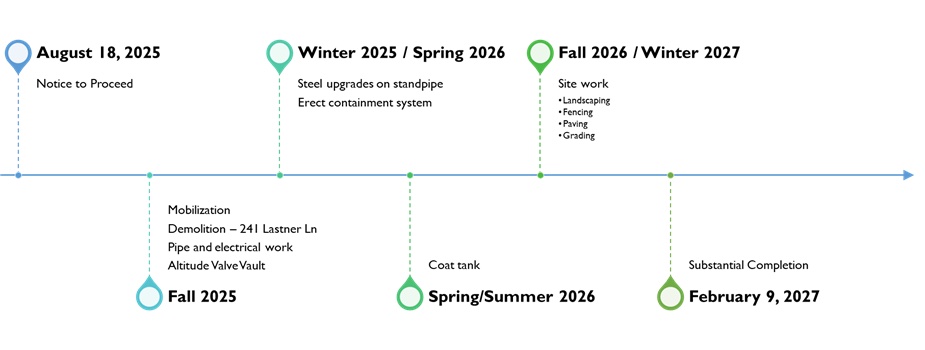
The home had been bought to create a staging area for work on the standpipe, which stores and supplies water for the city. While broader project information was shared publicly, residents say immediate neighbors received little direct, timely communication or added specifics.
Sandblasting Work
More recently, residents say sandblasting work to remove old paint from the standpipe has created sustained noise levels exceeding 100 decibels outdoors. Decibels varied depending on their house location and where within the house the resident stood.
“That sander causes around over 100 decibels of sound in that area,” Legg said. “From our house, it was 100 decibels.”
Inside homes, residents reported levels between 60 and 80 decibels for hours at a time, accompanied by physical vibrations of the sandblasting.
“For us, it was 65 decibels in the house, 85 decibels outside of the house, and it was just constant,” said Brower. “We’re not as close, but you could still feel it. It’s like a vibration and shaking for eight straight hours.”
Impacts on Residents
The noise has affected daily life, particularly for families with young children and pets. Without timely notice, residents need to brace for the noise impact or create an impromptu plan of action.
Residents were provided with earplugs, said Legg, but they are not entirely effective with children and toddlers.
“We both have toddlers and young babies as well,” Legg said. “So, it’s not something that you can just put headphones over them easily.”
Residents say the response from project representatives has been inconsistent. In one instance, residents said they were informed of ongoing work only after it had already started.
“This is going to be a two-day job today and tomorrow,” Brower recalled being told. The work ultimately extended beyond that timeframe without clear follow-up communication.
Residents emphasized that their frustration is not with the necessity of the project itself, but with the lack of communication surrounding it.
“At the very least, they can let us know when it’s happening, so I can make a plan to be gone as much as possible,” Brower said.
Other impacts include, but are not limited to, disrupted sleep schedules, inability to use outdoor spaces and stress on pets.
Legg has moved his daughter’s nap location to the basement because it is 80 decibels in her room.
“You can’t relax in your own home,” said Brower.
Outreach, Operations
WSSC facilitated various city and outreach meetings since 2023 to inform Greenbelt about the rehabilitation project and types of construction to expect. The last meeting was held virtually on November 12, 2025.
The construction contractors use a digital sound level meter to ensure they stay within 90dB at 100 feet from the source, says WSSC. In the next phase of work, which begins late spring/early summer, they will work on other methods to reduce noise and its impact on the community.
Construction hours are 8 a.m. to 5 p.m., Monday through Friday, with potential work on Saturdays, according to WSSC.
Prior to demolition, lead and asbestos were found in the house and standpipe. Careful removal, testing and disposal of both were strictly followed in accordance with all federal and state safety/environmental regulations, says WSSC.
“We understand this work has been disruptive at times, and we sincerely apologize to the community for that impact. We are committed to doing better with advance notification, especially ahead of louder construction activities, so residents know what to expect and when,” said Lyn Riggins, WSSC section manager, External Communications and Livestream Operations.
So far, the project is 40 percent complete.
While acknowledging the importance of maintaining public infrastructure, residents say clearer, more consistent communication would significantly reduce the burden.
Laura Charleston is a University of Maryland Philip Merrill College of Journalism student interning with the Greenbelt News Review.