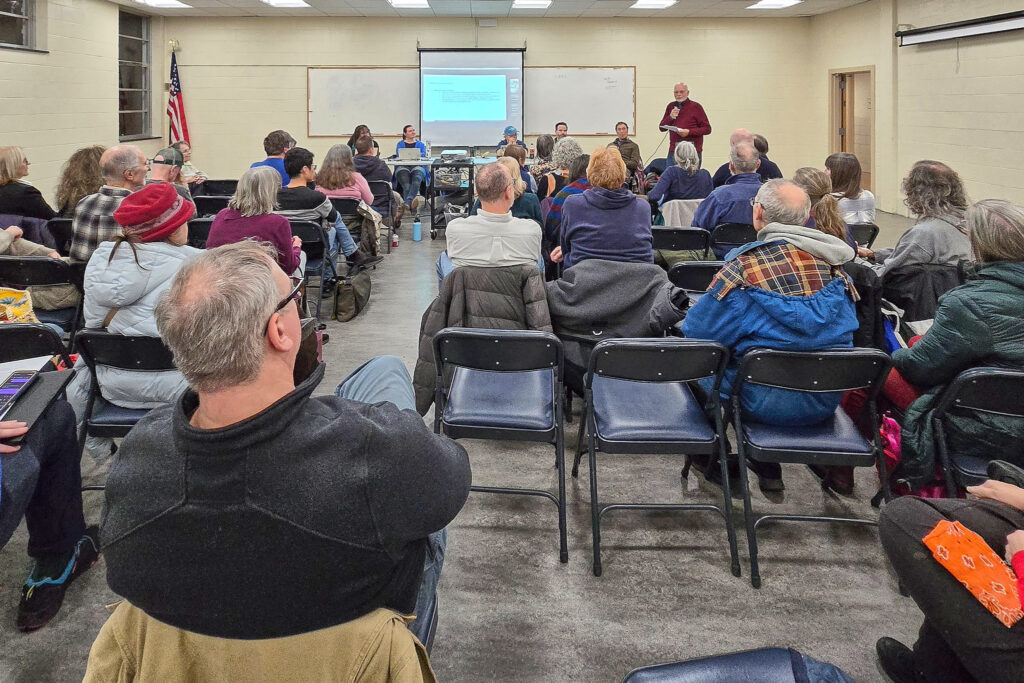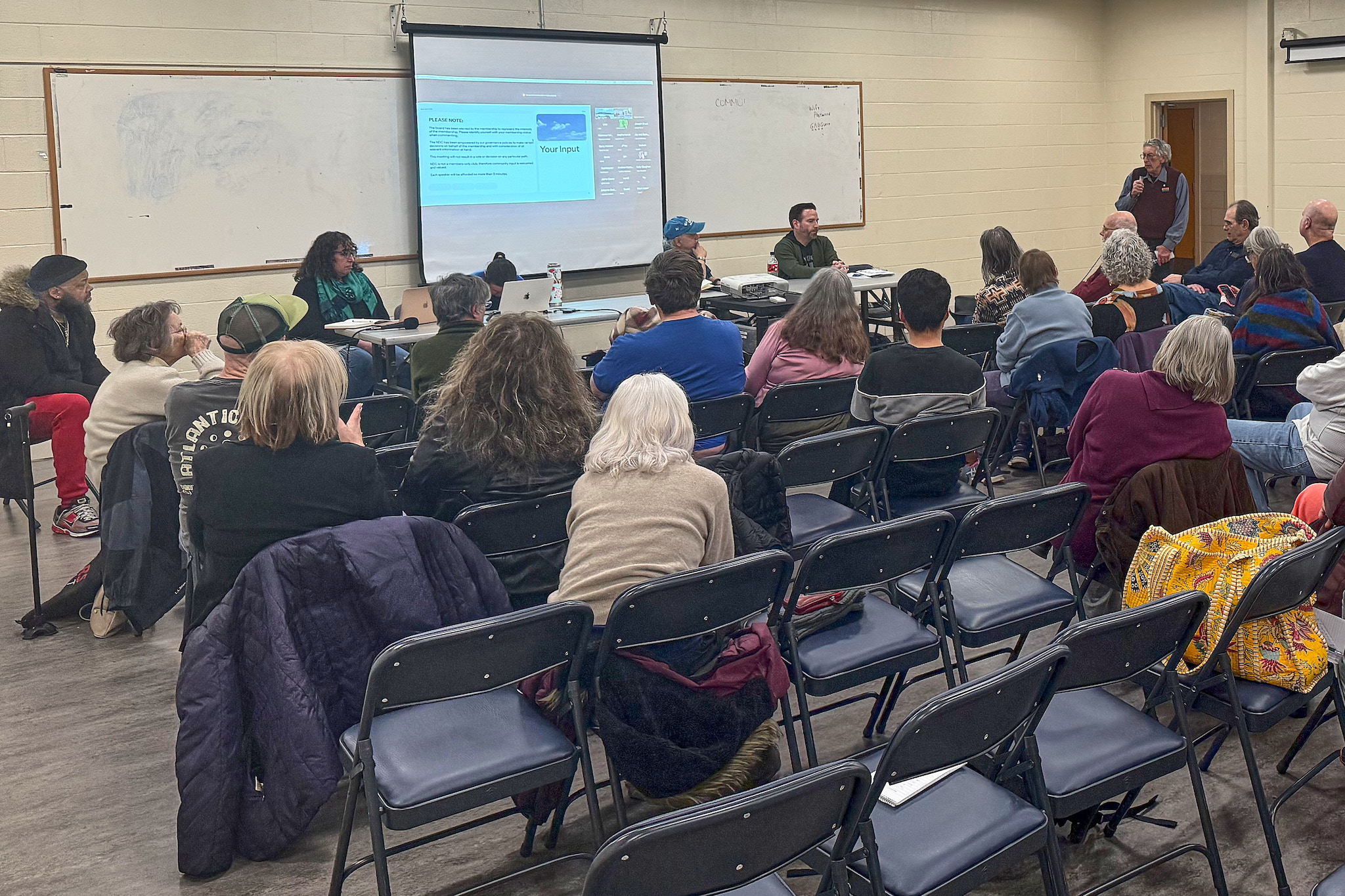
The New Deal Café is facing what its audit committee called a “major financial crisis,” as board members and vendor Kenny Hilliard publicly disputed responsibility for unpaid sales taxes and other overdue obligations during a tense membership meeting on February 10.
“No decision will be made at this meeting,” John Campanile, president of the Board of Directors for New Deal Café, said at the outset. “We expect a respectful dialogue. Our goal is to share information as clearly as possible.”
Campanile outlined a timeline dating back to September, when a performance review was conducted under contract stipulations. In October 2025, the Café’s entertainment permit renewal was denied “due to unpaid sales taxes totaling $44,934.14.” As a result, the music program was suspended for a few days in December after the existing permit expired November 30 and a new permit was delayed.
The board also identified additional past-due obligations, including utilities and rent. Payments to WSSC Water, Pepco and trash pickup are all overdue, according to the board. The Café’s sales tax payment plan with the Maryland Comptroller is now three months behind, said Campanile, who outlined fiscal concerns at the start of the meeting.
“We’re here because we have a letter from the State Comptroller on December 22 that says we’re going to have our liquor license pulled if we don’t have our taxes paid,” said Alan Parker, the Café board treasurer.
Rex Wingerter, speaking on behalf of the audit committee, said the committee’s review revealed deeper structural concerns. “We’ve got a major financial crisis,” Wingerter said. “The four percent surcharge just doesn’t work with the demands of revenue, the demands that we face. The vendor needs to generate more income. We don’t have the money.”
Wingerter said the board must now decide whether to continue working with Hilliard, seek a new vendor or consider ending the cooperative model altogether.
Financial Concerns
On February 9, the Café’s audit committee, chaired by
Wingerter and including Ray Zammuto and Teresa Petrovic, issued a memorandum to the board and membership outlining what it described as “historic, structural financial deficits.”
The memo states that the Café generated $69,459 in total revenue in 2025 but incurred $95,861 in expenses, resulting in a net loss of $29,821. Music and entertainment accounted for 60 percent of expenses, while the 4 percent surcharge represented 43 percent of revenue.
The draft 2026 budget projects a loss of $47,900 once previously omitted expenses and loan obligations are included.
As of February 7, 2026, the Café reported $25,245 in current assets against $148,353 in liabilities, including approximately $50,000 in member loans and a $98,000 Small Business Administration loan.
The audit committee memo concludes that the current business model “does not work,” stating that the 4 percent surcharge alone cannot sustain the music program and that consecutive operating losses and shrinking reserves limit the Café’s options.
The audit committee presented three policy options: negotiate a new cooperation agreement with Hilliard and potentially renew his contract; seek a new vendor, though the committee expressed skepticism about the feasibility of that path; or dissolve the cooperative, pay member debts, declare bankruptcy and seek a new operating entity to take over the space and music program.
“We believe that if the doors close at the end of the board’s relationship with Mr. Hilliard, they will not reopen,” the memo states.
Hilliard Disputes Claims
Hilliard rejected the characterization that he chose not to pay bills. “That’s not the case. That’s not true. Taxes have been paid,” he said.
He said the sales tax issue stemmed from how the point-of-sale system was configured. He believed the system would automatically collect and remit sales taxes to the state, as it does at his other restaurants, and said he was unaware taxes were not being transmitted after the Café switched to Square, a payment processing service. “As soon as we found out about the tax thing, we figured out what happened. I did exactly what I needed to do. I took $22,000 and went straight up here to the comptroller’s office and paid the money,” Hilliard said, referencing a lump sum paid toward the owed taxes when the remainder was made part of the payment plan.
Hilliard acknowledged the Café has struggled financially and said he has been subsidizing New Deal Café through his other businesses, including Kenny’s Kale. “We’re not making enough money or generating enough income at New Deal currently to handle a lot of things,” he said. “Kenny’s Kale is carrying the weight of New Deal Café.”
He argued that he needs greater operational autonomy to make the business profitable. “The board has to take their hands off what I know I’m doing,” Hilliard said. “I need to run a restaurant.”
Board member Stephanie Rizk disputed that the board has micromanaged him. “We absolutely do not dictate the menu. We do not dictate the prices,” Rizk said. She did acknowledge that the contract signed by Hilliard and Campanile in July of last year does stipulate certain things, like requiring vegan and vegetarian options.
Tax Payment Plan
The most urgent issue is the state tax payment plan. According to the board, approximately $26,000 remains owed to the state, and a payment must be made by February 15 to avoid further consequences.
Tensions rose during an exchange over what payments had been made and how they were applied. Under the Café’s structure, the cooperative holds the sales tax account with the state and submits payments, while Hilliard is responsible for providing the funds. Hilliard said he had directed money toward the payment plan. “I said, please make the payment for the payment arrangement,” he said. Hilliard said he provided money toward the tax payment plan that hasn’t been applied to it.
Parker responded that, regardless of how funds were earmarked toward which debt, the debt still exceeded payments and the state still shows months unpaid. “As of February 15, the State of Maryland is owed three months on the payment plan,” Parker said.
Several members urged both sides to work together and avoid escalation. “We hire Kenny to provide the food and beverage, and that’s what he’s doing and we support him,” one member said.
Hilliard closed by pledging to resolve the immediate crisis. “We’re not going to lose the liquor license,” he said. “I’m not going to allow New Deal to close on my behalf.”
Campanile said mediation, required under the contract, is being pursued and urged continued patronage. “The best thing you can do to help out right now is your continued support and patronage of the Café,” Campanile said.
As of February 16, no decision has been made pertaining to the future of the New Deal Café.
Stephen Lotz is a University of Maryland student at the Philip Merrill College of Journalism interning at the Greenbelt News Review.