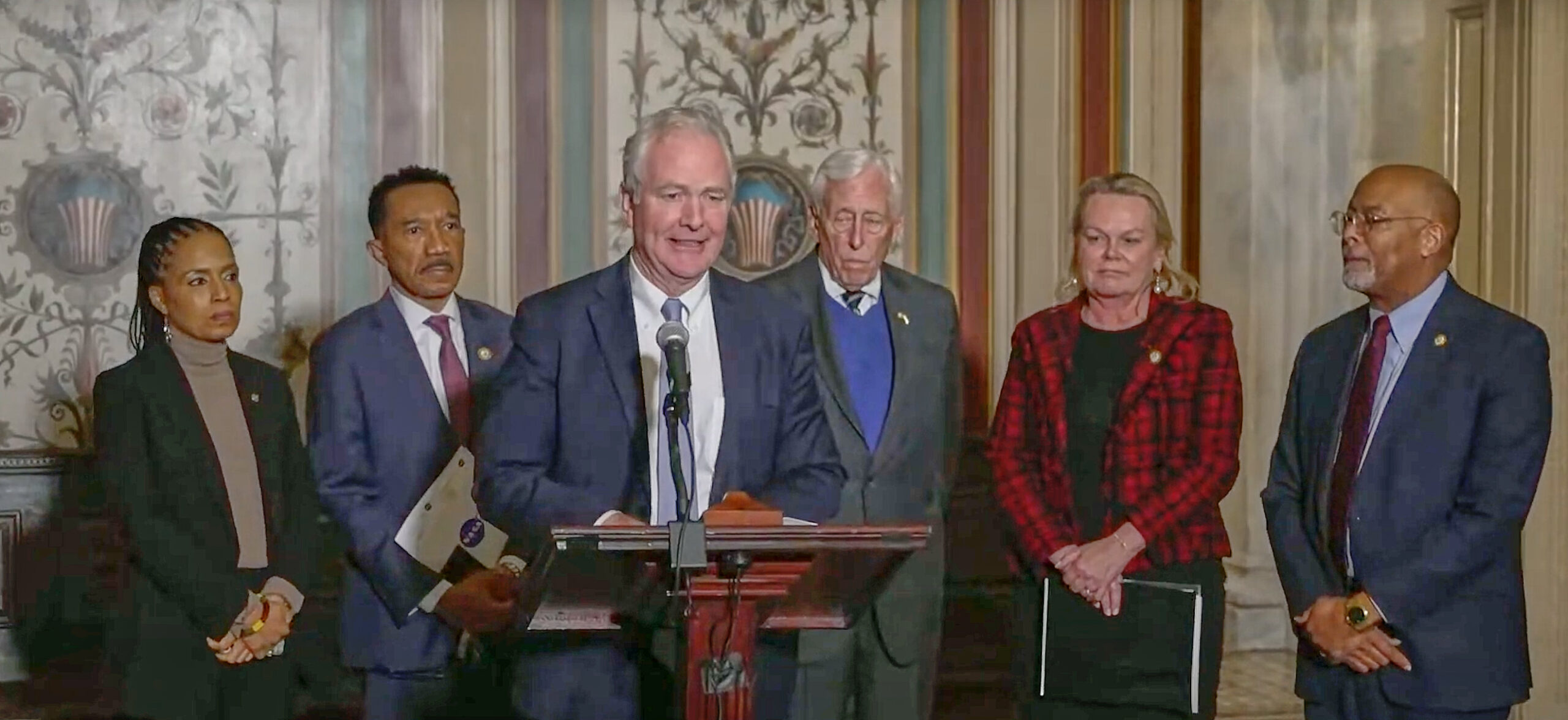
On Monday, December 15, members of Maryland’s congressional delegation met with NASA officials and stakeholders to discuss Goddard’s workforce and missions. “The NASA Goddard story is part of a larger story where the Trump administration has really eaten away at American leadership in many areas, including when it comes to space and innovation and exploration,” said Sen. Chris Van Hollen (D), following the meeting. “One of the areas they’re cutting is space science, and if you think about it, you can’t have a space program if you don’t have the space science,” said Van Hollen. “The big takeaway is that the Trump administration is really eating away at our competitiveness around the world. They are ceding ground to China and our adversaries and we are pushing back here with everything we’ve got.”
Goddard Closures
Asked about Goddard building closures, Van Hollen said, “We’re all going to monitor the building closures very carefully to ensure there’s no loss of actual capacity.” He said some buildings were empty and some consolidation needed to happen but “it’s been haphazard, it’s not been done in consultation with the employees, it’s not been done in a smart way so we’re going to continue to monitor that effort.” He said the delegation is focused on projects at Goddard and hoping to even accelerate funding for some.
Rep. Steny Hoyer (D) added that the plan being executed “predated this administration,” referring to the 2019 20-year Master Plan Goddard leaders have said they are following. It’s a claim disputed by employees who spoke with the News Review (see the September 23 issue.) A key objection is that the Master Plan called for modernization and construction of new buildings in addition to closings and demolitions, and was to occur over years, not months.
Loss of Human Capital
Americans are losing scientific opportunity and expertise as people leave the U.S. to work for competitors elsewhere in the world, said Van Hollen and others. “If you look at Goddard, they were one of the victims early on of Elon Musk coming in with a chainsaw. And they were offered these forks in the road and early buyouts and the result was about a 35 percent cut in the Goddard workforce,” said Van Hollen. The Goddard workforce of about 10,000 civil servants and contractors has fallen to around 6,600, he said. Sen. Angela Alsobrooks (D) called the cuts “indiscriminate” and a “smash and grab,” alleging “they don’t even understand what they have damaged and destroyed.”
Alsobrooks stressed that the individuals being cut had 20 years’ experience on average, and 45 percent of those lost were
engineers, so while work is done to defend and restore funding, the expertise is not easy to replace. Hoyer said the administration had attempted to cut trillions of dollars from the budget and perhaps a million federal employees, but did so “not with a scalpel, not with knowledge of the consequences of their actions but with a chainsaw and a focus only on numbers.”
Rep. Glenn Ivey (D) noted NASA’s loss of experienced workers was accompanied by a hiring freeze preventing recruitment of young talent. “We don’t need another Sputnik moment,” said Ivey. “We need to make sure that we do everything we can to hang on to that human capital, that human talent, the genius that has made NASA the envy of the world. These are patriotic people doing great work. We need to make sure we give them the opportunity to continue to do that because the U.S. needs it, and frankly, the world needs it,” he said.
Fighting Funding Cuts
Overall, the Trump administration proposed cutting NASA’s budget by 24 percent, to the lowest level since 1961. However, most of those cuts are in the Science Mission Directorate where the president’s budget proposes a 47 percent cut.
Van Hollen said the Maryland delegation is fighting Trump’s proposed cut to the Space Science budget. He reported that the Senate’s Commerce, Justice, Science and Related Agencies (CJS) Subcommittee “rejected entirely those cuts,” saying they instead increased their science investment to support Goddard.
Hoyer noted “the Senate, under Republican control, did not accept those cuts,” and he further celebrated a House proposal to reduce the 47 percent cut to 16 percent. He warned against continued loss of talent to Europe and Asia. “Let us hope that the American people will say to Congress, ‘Do not disinvest in science; that is the future,’” said Hoyer.
Van Hollen outlined Goddard’s importance to the state and the region. He noted the Eastern Shore’s Wallops Space Flight Facility is part of Goddard and that Johns Hopkins’ Applied Physics Laboratory (APL) works heavily with Goddard, so its future is also affected by this fight. He noted Goddard’s Nancy Roman Space Telescope is ahead of schedule and under budget. “The Trump administration was going to cancel that mission,” claimed Van Hollen. “That’s back on track,” he said, “and we’re working to get other major missions on track and in some cases accelerated.”
Rep. Kweisi Mfume (D) said the Maryland delegation is issuing “a clarion call to our colleagues in the House and Senate to understand that the U.S.A. is on the threshold of losing its dominance in the area of space science and technology.” “The work that goes on at [Goddard] and [APL] is work that cannot be produced overnight, and if we lose that dominance we will find ourselves playing catch-up to the rest of the world,” said Mfume.
Rep. April Delaney (D), who sits on the House Science Space Technology Committee, warned the “cuts” are going to cost more in terms of impact to the economy and nation.
Praise for Goddard
Hoyer called Goddard an extraordinary asset to Maryland, the U.S. and the global community which has relied on Goddard and NASA “for all sorts of different reasons, including national security, including agricultural production, including saving ourselves from extraordinary weather events …”
Jared Isaacman’s (Re)Nomination
The nomination of Jared Isaacman as NASA Administrator proceeded this month with committee approval and a second Senate hearing, with confirmation expected soon. Isaacman was first nominated in December 2024 but, after committee approval in April, Trump withdrew his nomination, due to what he called a “thorough review of prior associations.”
Van Hollen said Monday that Isaacman has a “positive vision of the space program, including a recognition that you can’t have a space program without fundamental research, the space science, so we’re on the same page.” Van Hollen did acknowledge concern over a leaked document authored by Isaacman that “talked about poaching some of the assets from places like Goddard and transferring them to other sites in the country.” Van Hollen speculated that it was leaked by someone who didn’t want Isaacman confirmed and said Isaacman told him he is not interested in pursuing the ideas in that document. “My view is ‘show me,’” said Van Hollen. However, “he at least said that he understood the Goddard mission and how important it is,” Van Hollen added.