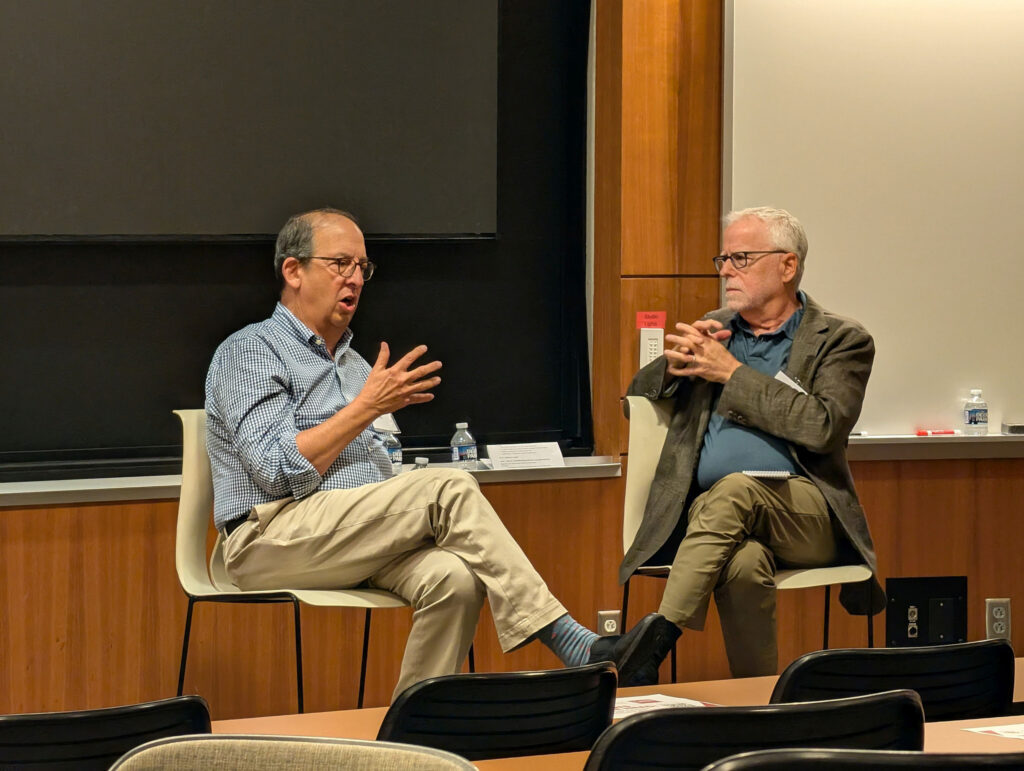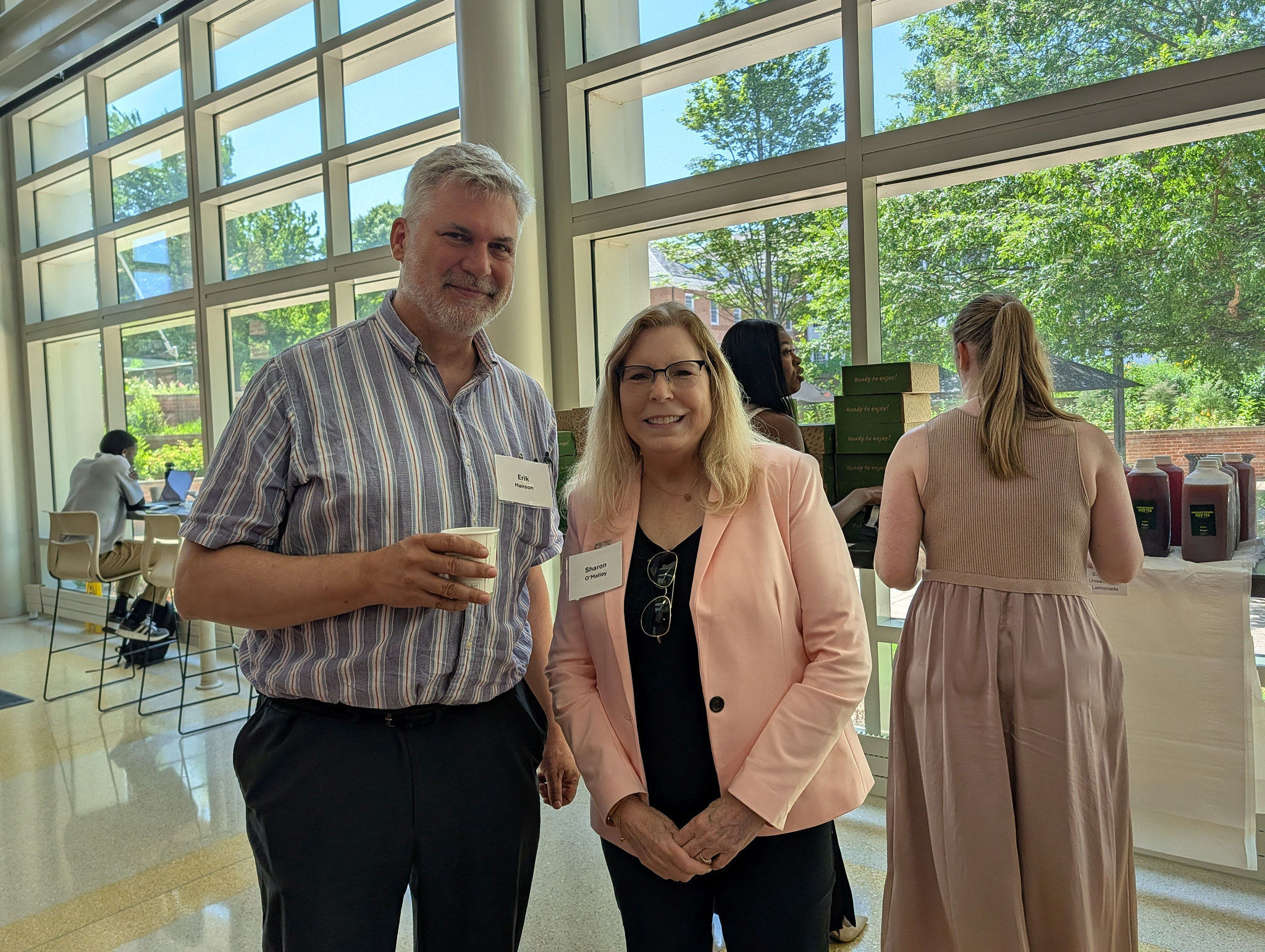
On June 12, journalists, media scholars and news leaders from across the region gathered at the Philip Merrill College of Journalism on the University of Maryland (UMD) campus for the annual Local News Network Summit, a day-long event focused on the future of local journalism. Among those attending were the Greenbelt News Review’s Managing Editor Anna Bedford-Dillow, News Review council reporter Erik Hanson and News Review intern and UMD journalism student Cam Crossett.
The conference centered on a newly released report examining how Maryland residents define local news and what they want from news organizations. The opening session was moderated by Tom Rosenstiel, lecturer and Eleanor Merrill Scholar on the Future of Journalism. Presenters included Tran Ha, founder and principal of Tiny Co Strategy Studio; Sean Mussenden, director of UMD’s Howard Center for Investigative Journalism; and Krishnan Vasudevan, associate professor at Merrill College.
Using a human-centered design approach, researchers interviewed 17 Maryland residents ranging from a University of Maryland student to an Eastern Shore retiree. Rather than relying on large surveys, researchers sought to understand residents’ motivations, values and daily information needs. “We always start with desirability,” Ha said. “Understanding what people value and what their needs are as it relates to what we’re providing.”
What’s Local?
Researchers found that Marylanders define “local” differently based on personal influence, identity and community connections. Depending on context and community, local could be a neighborhood, city, county, state or region like the DMV. Participants also said local news often focuses too heavily on crime while overlooking positive developments in their communities.
The study identified six key functions, or “jobs to be done” for local journalism: helping residents take action on issues affecting them, providing historical context, exposing systems that shape daily life, explaining the local impact of policy decisions, delivering timely and actionable information, and celebrating community life.
Mussenden said journalists should think more intentionally about whether their reporting helps readers respond to important issues.
Serving the Community
A second panel, Maryland Journalism’s Job to Be Done, explored how news organizations can apply the report’s findings. Panelists included Christi Parsons, Capital News Service’s Washington bureau chief; T.J. Ortenzi, deputy editor of audience and digital at the Baltimore Banner; Kit Slack, executive director of Streetcar Suburbs News; and Jesse Yeatman, managing editor of Southern Maryland News.
Speakers discussed balancing limited resources that newsrooms are increasingly facing with audience needs and emphasized that organizations should prioritize the functions most valuable to their communities.
Reaching Audiences
The conference’s third panel, Reaching Audiences in the Hyperlocal Future, examined practical ways journalists can provide context, resources and actionable information. Moderated by Jerry Zremski, director of the Local News Network at Merrill College, the panel featured the American Press Institute’s Yoni Greenbaum, Vasudevan and Merrill College professor Daniel Trielli. Though it’s likely artificial intelligence (AI) will replace human writing for “commodity content” — generic, aggregated information, for example — it can’t capture how that impacts people locally. “Newsrooms will discover that they are no longer needed, that they won’t need as many reporters,” said Greenbaum. “AI is going to replace what too many newsrooms, I believe, have called journalism ‘community content.’” The hyperlocal is frequently what the reader looks for and community knowledge and connections are what AI can’t replace, suggested the panel.
The conference concluded with a conversation featuring former ProPublica President Richard Tofel, who discussed the economic challenges facing journalism and the growing role of artificial intelligence in newsrooms. Speakers emphasized AI’s usefulness for research, data analysis and monitoring public meetings, while still raising concerns about accuracy and job displacement.
Audience Needs
Following the conference Rosenstiel and Zremski reflected on its purpose. “This year was very much a follow-up to what we did last year,” Rosenstiel said. “What we did this year was a year-long study in depth to say, ‛What would those needs be here in Maryland?’”
Zremski said the conference has evolved from focusing on business models to examining the type of journalism communities actually need. “We’re really teaching them something that’s of value that they can take from here and implement in their newsrooms,” Zremski said.
Attendees said the conference’s emphasis on audience needs reflected broader changes within journalism.
Hanson, of the Greenbelt News Review, said he attended to learn how others were thinking about local news in Maryland. “I appreciated the broad framing of the news business model that was given at the conference,” he said. “In the 20th century, news gathered attention and then sold advertisers access to that attention. Today, much of the surrounding information people once relied on newspapers for — weather, job listings, sports scores, etc. — comes from elsewhere, so local journalism has to focus more directly on serving readers and their needs.” Hanson said two remarks from Rosenstiel particularly stayed with him: “The local is where I have influence” and “How will this story help someone?”
As local journalism continues to adapt to technological and economic change, conference organizers said understanding audience needs will remain central to its future.
The News Review will celebrate 90 years of continuous publication next year. It is steeped in history and also looking to the future of local news.
Cam Crossett is a University of Maryland graduate student at the Philip Merrill College of Journalism and intern at the Greenbelt News Review.