Prince George’s County Public Schools (PGCPS) Director of Transportation Keba Baldwin stepped down following what parents across the district reported as a
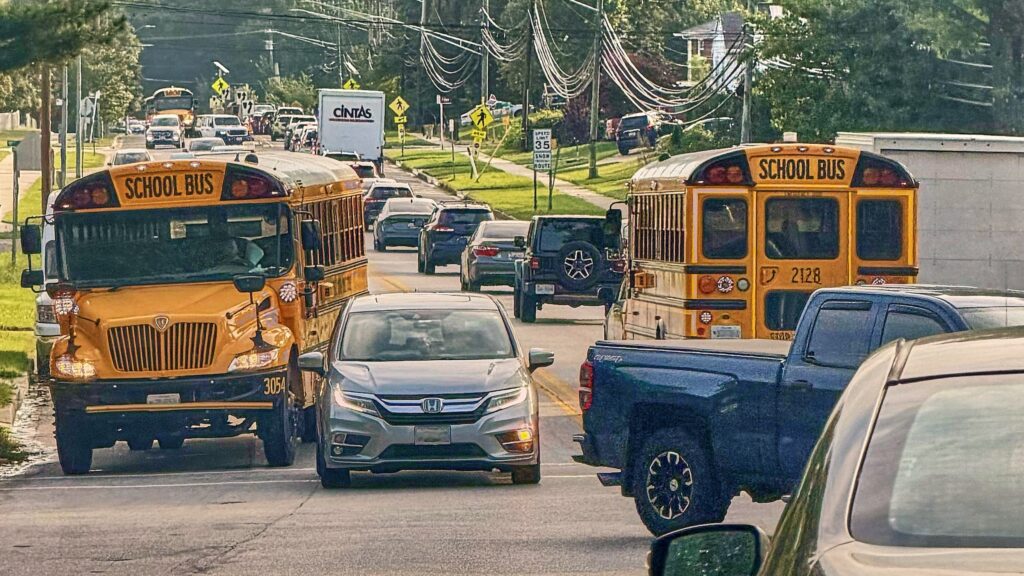
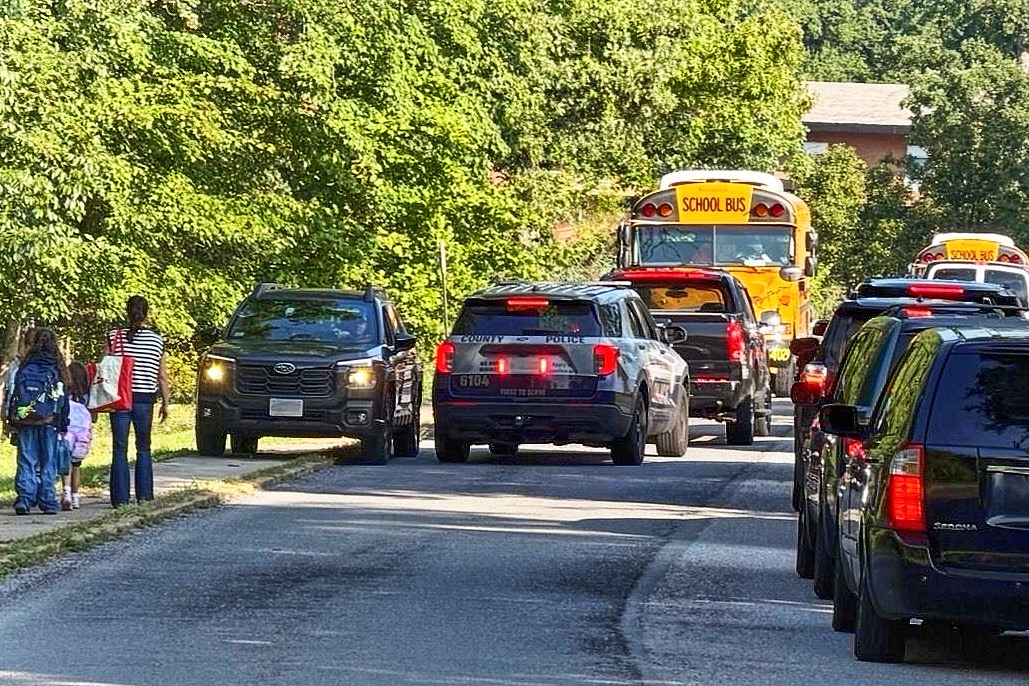
disastrous first week for school transportation, which also saw the crash of the county’s bus tracking app, Chipmunk, on the first day. The backdrop for much reporting on transportation issues were lines of cars and buses at the newly co-located Dora Kennedy French Immersion (DKFI) and Robert Goddard Montessori schools, where traffic sometimes stretched along Good Luck Road during the first week. Parents from DKFI also filled the school board meeting last week to share their concerns.
DKFI and Goddard Co-location
In preparation for approximately 700 DKFI students, two-story modular classrooms were constructed at the Goddard campus. But no apparent changes were made to accommodate the increase in traffic, which was already problematic according to Robert Goddard parents. While in Greenbelt, DKFI split dismissals across a loop on
Edmonston for older students and Greenbelt Road for younger ones and traffic still caused lines on surrounding streets around bell times. Since the announcement of co-location, the school communities repeatedly raised concerns about the single in-and-out road serving the two schools and a bus lot. At prior meetings, PGCPS administrators told families an additional entrance or exit at the Goddard campus wouldn’t be feasible. Senior Public Information Specialist Lynn McCawley was unable to say by press time what PGCPS had done to prepare for the additional traffic at the site but said, “it’s important to note that this past week would not reflect an expected daily traffic pattern, since a large number of students who had missing or incomplete bus assignments were being driven to and from school.”
School Board Meeting
The August 27 Board of Education meeting was dominated by calls for accountability and testimony about failures and frustrations that first week. To applause, Board Member and Vice Chair Phelton Moss amended the agenda to add a new business item: a review of the Chipmunk contract. However, drivers and parents weren’t placing all the blame on the app.
Bus Driver Perspective
Bus Driver Melissa Bergeron shared her run sheet to show her routes that run concurrently and explain why students are “arriving later than ever this school year.” Bergeron’s second, third and fourth morning routes are all scheduled to begin before she finishes her first one at 7:12 a.m., she said. “The result: every one of my morning students after my first school is late,” Bergeron said. Eleanor Roosevelt High School is her third route and she’s 70 minutes late by the time she makes it to her first stop. Students give up waiting so her later routes are empty, she said. This is not an isolated problem, Bergeron testified; similar run sheets that are impossible to execute are being issued at all 12 bus lots. “How are we supposed to fulfil the mission of transportation — to transport students to school safely and on time — when the schedules themselves make that impossible? You have literally set us up to fail,” she said.
Another bus driver, Terrie Middleton, complained, “Management is trying to blame tech glitches for a crisis created by leadership.”
“Leadership admitted we weren’t properly trained on this new routing software before it rolled out,” added Middleton. “In fact, some of our buses are not even equipped with the software, and as drivers we have not even seen the software.” Middleton said drivers were arriving hours late to face frustrated parents yet have their daily schedules restricted to eight hours, and retention and overtime incentives had ended earlier in the year. “We don’t need million-dollar software contracts; we need functional routes and fair compensation,” said Middleton.
Another driver shared concerns about students missing the opportunity to eat breakfast as well as instructional time.
A router’s statement read at the meeting said they had learned five routing systems in nine years. This one is geared toward data and tracking rather than routing, they said. In addition, the time for completing the routing is shortened every year, and routers are rushed to complete the tasks, often without overtime, they reported. The routers have raised complaints annually, they said.
Parent Testimony
Caroline Decaire-Goldin, PGCPS parent, former PGCPS teacher and District 2 school board candidate, highlighted the two-hour Dora Kennedy and Robert Goddard drop-off lines and unreliable busing in her testimony. “It is a privilege to have a car to go find your child [and] to be able to drop everything when a bus doesn’t show to drop them off or pick them up. That is not an education system that works for every child and that’s not equity in action,” said Decaire-Goldin, calling on PGCPS to include bus drivers’ voices in solving the problem.
Parent Theresa Smith told the school board she had lost faith in the department of transportation. She shared problems her children have experienced with school buses back to 2013. This year one of her children has no assigned route. “We express concern about truancy yet the system cannot get scholars to school,” said Smith. “I don’t need another person telling parents to be patient. Our scholars are being left on the curb and I cannot stand by while families navigate this dysfunction alone. There are gaps in the process, and it’s bigger than an app. … Find the human element and get our children to school and back home on time.”
Parent Dominique Lewis, whose children’s bus had not arrived two days in a row, called the experience “more than a first week transportation problem; it is a communication and accountability problem.” She isn’t asking for perfection. “I am asking when something goes wrong why can’t anyone tell parents what’s going on?” Lewis said and pressed PGCPS why the district faces the same problems “year after year.”
DKFI parent Carrie Weletz called the start-of-year transportation plan “a complete and utter failure.” She spent two to three hours daily transporting children to a school 8.8 miles away. The day before it took her 45 minutes to move six car lengths on Good Luck Road in traffic to DKFI, she reported. She’s also had to arrive two hours before dismissal to try to get her children home earlier. “If a student cannot reliably get to and from school, that student is being denied access to their education,” said Weletz. “The first day of school happens every year,” she told the board, adding that the school system has months to prepare. Weletz asked what traffic studies PGCPS had done in advance at DKFI/ Robert Goddard, whether they had accounted for parents driving when buses proved unreliable, and whether they had considered the safety implications of buses and cars riding on sidewalks on one feeder road in and out of the school. The problems were not unexpected, she said. “The county wants me to give them grace. … I would have less of a problem extending this grace if this county did not experience this same problem each and every year …”
DKFI parent Rebecca Fleeson testified, “What is happening with transportation and the co-location of the Robert Goddard campus is not simply a difficult start to the school year or something that can be fixed with more volunteers or our leadership showing up for one bus-loading time. It is a foreseeable safety, operational crisis that parents warned PGCPS about two years ago.” Fleeson also spoke of buses and cars on the sidewalk used by students along the access road. “When there is a bus in the wrong lane and a car line that lasts two-and-a-half hours, the buses drive on the sidewalk that students walk on … PGCPS does not provide the basics: transportation, parking, safety.” Fleeson said two of her four children had no assigned morning bus and the other two had rides of nearly three hours one way, for a 5-year-old to travel eight miles to school. “I am asking PGCPS leadership to seriously reconsider the long-term facility plans for DKFI. The exceptional school deserves a permanent, appropriately-sized home, with a safe road and pedestrian access for its students and staff,” said Fleeson.
Parent Lance Escher testified that this is the worst transportation situation he’s seen since his children began riding buses to attend DKFI in 2019. Their bus pick-up time is two hours before school starts and his children waited at school until 6:20 p.m. one day when no afternoon bus arrived. Doubling ride durations has meant parents abandoned buses, said Escher, which in turn led to huge traffic jams and two or more hour waits to drop off and pick up by car. “Things cannot go on this way. Parents are making sacrifices at their jobs: taking leave, working late or literally foregoing wages to drive their kids in when they would much rather have their kids ride the bus. And the kids who stick with the bus are being punished. They’re losing time — time with their families, time to attend extracurriculars, time to do homework and time to sleep,” said Escher. He called on the administration to shorten bus routes, calling three- and four-hour commute times untenable. “I doubt anyone sitting in front of me would agree to accept a position that would require them to commute for three or four hours every day but you are asking that of children as young as 5 years old. Please fix this,” he said.
DKFI parent Courtney Harrah refused to blame failures on an app rather than an entire department of transportation. Like others, she noted, the difficulties at the start of this school year were beyond the regular challenges that unfold every September.
Harrah spoke of a middle schooler offering to stay home from school so her mother could make her radiation treatment the next morning instead of trying to get her to school. Harrah herself had to put her highschooler in an Uber or Lyft to get them to school each morning while taking leave daily as she has spent five hours transporting children.
“How many are making decisions between sending their children to school and keeping a job, receiving cancer treatments? Students are missing hours, days of education time simply because they cannot get to school. We are tired,” she told the board and administration.
Carolyn Lemm Espinoza, a DKFI parent of three, reiterated the situation was beyond normal first-week transportation woes, noting problems were clear in advance and PGCPS never delivered the bus routes promised by August 18. She called the outcome — including her child’s afternoon route that doesn’t arrive until nearly three hours after dismissal — “the plan PGCPS leadership designed,” not a first-week glitch.
McCawley told the News Review on Tuesday that “significant progress addressing the traffic and congestion challenges” at DFKI and Robert Goddard has already been made. A team including Safe Passage, safety and security, transportation, school leadership, county police, PTA and parent volunteers have worked to redesign the morning traffic pattern, McCawley said. Immediate changes include allowing students to enter the building 15 minutes earlier and establishing separate traffic patterns for buses and cars, said McCawley. PGCPS is now working with the county government to explore the possibility of crossing guards at the traffic signal at Palomar Drive and Good Luck Road during arrival and dismissal, she said. District 1 school board member Tiffini Andorful, who represents the schools in Seabrook, did not respond to our attempts to reach her by phone and email.
At the board meeting Superintendent Shawn Joseph apologized. He said PGCPS would be adding staff, including in routing and scheduling. Meanwhile, Vice Chair Moss called for an audit of the $3.2 million Chipmunk app contract, to which the board agreed.
A districtwide transportation townhall was planned for Wednesday, September 2.
In the second week of school, students in Greenbelt navigating the school buses continued to report long waits and missed stops and buses that didn’t arrive.
The author has two children who attend DKFI.