Never before has a human-made object reached so far in space.
On November 18, at 5:16 a.m. EST, NASA’s space probe Voyager 1 reached a full light-day — more than 16 billion miles — from Earth, becoming the farthest human-made object to ever have been propelled that distance into space.
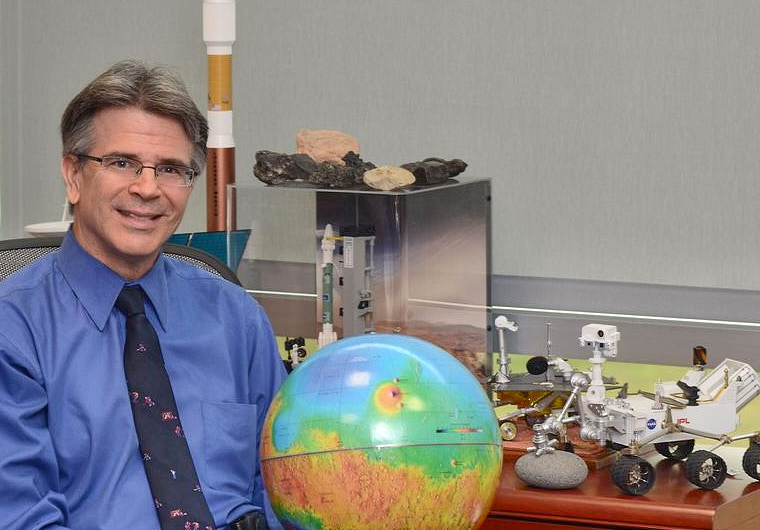
In light of the historic occasion, the Greenbelt News Review sat down with James Garvin, chief scientist at Goddard Space Flight Center, to talk about Goddard’s role in Voyager 1’s activities over the years — that is, in having produced key instruments that Voyager 1 uses to study these far away regions, and in studying interstellar data.
“It’s kind of like a kid-in-a-candy-store environment,” Garvin said, in describing what it is like for space scientists at work every day. “And then you have these milestone events: 50 years to cross interstellar space one light-day away.”
Voyager 1 was originally launched in 1977, a couple of weeks after its twin probe Voyager 2 — but, as NASA’s public information webpage on the mission explains, it exited the solar system first and thus to date has travelled farther.
Garvin explained that this is not simply a meaningless milestone: Voyager 1 is giving scientists the opportunity to study interstellar space — a place where humanity has never been before.
When asked how he would explain interstellar space to a 10-year-old, Garvin gave this answer:
“We live in a neighborhood. It happens to be a solar system, meaning it’s got the Sun — a star,” he said, adding, our sun is “a beauty, we’re lucky to have it.”
“And there are a series of objects — or bodies as we call them, like planets, asteroids, comets and dust. The space in our solar system is solar system space. Beyond that is the space between stars. That’s interstellar space … the area of this universe between where there are solar systems and where there are not.”
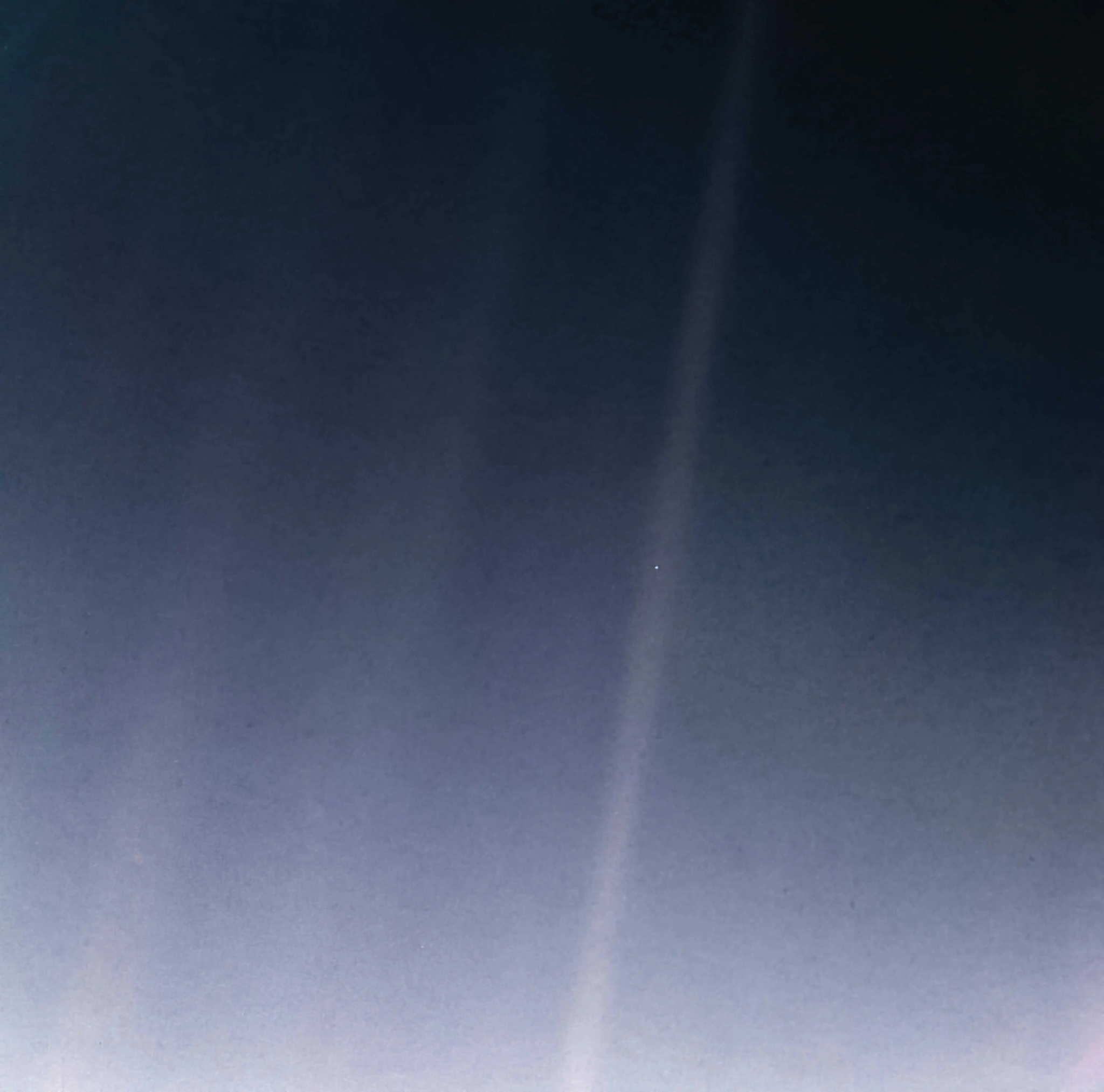
Garvin explained that Goddard scientists played a major role in the instruments on Voyager 1, from the magnetometers, the photopolarimeter (an infrared spectrometer) to Voyager 1’s Imaging Science Subsystem — which was responsible for the famous Pale Blue Dot photo.
As the News Review reported last week, the magnetometers (specifically the Low-Field Magnetometers) are one of the two remaining devices still on — the rest, except the Plasma Wave Subsystem, having been turned off to conserve power.
Formally known as the Triaxial Fluxgate Magnetometers, they were built at Goddard by a team of scientists led by Norman Ness, who was succeeded after his death by principal investigator Adam Szabo. In making reference to people at Goddard who made historic contributions to the Voyager 1 mission, Garvin mentioned the late Mario Acuña, whose work in the 1970s at Goddard, he said, was essential to magnetometer science and Voyager 1’s magnetometer mission.
Acuña and Ness were authors — along with other Goddard scientists including Leonard F. Burlaga and Ronald P. Lepping — of the first published preliminary results of the Voyager 1 and 2 Magnetic Field Experiments, in the leading journal Science in June and November 1979.
“Voyager’s magnetometer saw the massive magnetic fields and radiation fields as we flew by Jupiter, produced by Jupiter — which is almost big enough to have made it another star, but just failed — and so we made those discoveries with the team that built the magnetometers here,” Garvin said, giving an example of the magnetometer’s accomplishments.
Garvin explained that planets function like giant magnets — their spinning creates magnetic fields that can be measured — which is the job of the magnetometer. “That was discovery at its most pure.”
When asked how Voyager 1’s transmitter manages to send signals billions of miles away across the universe — despite only having about 23 watts, which NASA communications routinely compare to as the power wattage of a refrigerator lightbulb — Garvin said, “That lightbulb worth of power is operating at a wavelength we would call ultra-high frequency.”
He explained that it can be transmitted in a very narrow way. “We’re able to send those pulses with very low information content, but with enough signal that we can separate the noise of deep space, the cosmic background, from this signal, because of the patterns.”
Garvin described the revolutionary nature of the Voyager transmitters.
“It’s the nature of really creative engineering that allows us to listen to signals and make two-way communication patterns to systems as far away as Voyager [is now]. It bodes well for having solutions that will eventually allow us to have interstellar probes that actually go to the nearest star system, like Alpha Centauri — which is four light years away.”
Scientists around the world — at large radio telescopes in California, Spain and Australia — collect these signals, as part of the Deep Space Network. While Goddard doesn’t do the collecting of these specific interstellar signals from Voyager, he said, they do take part in interpreting signals from interstellar regions.
“We study particles and fields from the farthest echoes of the Sun, kind of like the gentle crashing of waves of energy, 16 billion miles away. That’s what we’re trying to do.”
Garvin closed by remarking about the magnitude of Voyager 1’s milestone.
“In some ways, it’s magical that we could even imagine this. When we launched Voyager, we never knew we could listen this far.”
When asked how long Voyager 1 has left, Garvin said his prediction was purely personal. “I’m just going to be fair with you, and everyone,” he said. “It’s so far beyond the shelf life we expected when we launched it.”
“We want to keep it alive as long as we can because it’s like a heartbeat beacon in space, measuring just the little bit of what we can.”