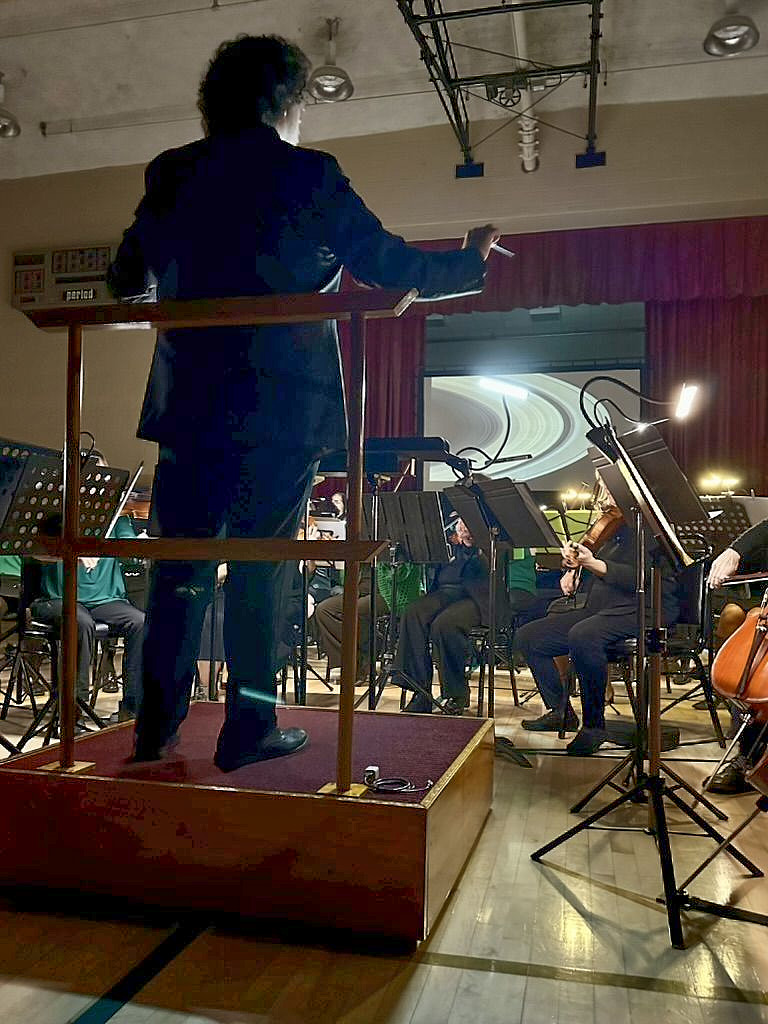
The Greenbelt Community Orchestra staged a stellar performance of Gustav Holst’s The Planets on Sunday, November 15 at 3 p.m., which brought the standing room only (SRO) Community Center audience to its feet. The program also featured the first movement from Mozart’s Symphony #41 (Jupiter) and Viet Cuong’s Constellations. The Holst and Cuong works were accompanied by NASA images of planets, stars and galaxies. An earlier concert was also given to an SRO house on Saturday evening at 7:30 p.m.
Seth Glabman conducted the Mozart and Cuong pieces. He introduced Mozart’s symphony by reminding the audience that Mozart’s work is known for its variety and contrast. Following the bold opening chords, the orchestra showed versatility in instrumental skill and overall dynamics.
Cuong overlaid maps of the astrological signs Virgo, Aires, Sagittarius and Leo on a traditional orchestral seating chart so that the placement of the stars determined which musicians would be the soloists when he wrote Constellations. Each of the four themes was played by its chosen group of “stars,” then the themes were played together with the full orchestra before returning to the Virgo theme.
Greenbelter Jonathan Gardner, an astrophysicist who has worked on Hubble and the James Webb Space Telescope (JWST) at Goddard Space Flight Center (GSFC), developed an accompanying slide show of images from Hubble and JWST, which were projected on a screen behind the orchestra. The images were beautiful, had a pulse of their own and, as arranged by Gardner, fused perfectly with the music. During the Sagittarius section, in honor of the fifth anniversary of the JWST launch on December 25, 2021, Gardner depicted a sequence of the launch and an animated deployment of the telescope which ended with a timpani crescendo perfectly timed to a burst of starlight — the first JWST image.
Holst’s The Planets requires a wide diversity of instruments and impressive technical skill. The 64-piece orchestra decided that they loved the music, had the range of instruments and wanted the challenge. The new conductor Caleb O’Neill agreed in his audition to take it on. Holst’s seven movements seem to be a series of mood pieces that loosely reflect the astrological and mythological overtones of the planets. Holst experiments with rhythm, tonality, dissonance, lyricism, dynamics and volume changes to create his ambience. The orchestra managed the variety and challenges superbly: the harmonic dissonance of warlike Mars; the lyric peace of Venus; the bi-tonality of quicksilver Mercury; the exuberant, broad chords of the abundant Jupiter; Saturn’s slow march marking time; the tricky rhythms of the magician Uranus and finally the quiet dissonance of the mystic Neptune, subsumed in fading voices. Members of the College Park Chorale, conducted by Allison Hughes, joined with the orchestra for the Neptune movement.
Before each movement, Padi Boyd, another GSFC astrophysicist, spoke about the latest scientific discoveries regarding each planet. Images of the planets compiled by the GSFC Visualization Studio accompanied each movement.
A 23-year-old master’s degree candidate in conducting at the University of Maryland, O’Neill accepted the challenge of conducting The Planets because he has “always had a deep passion for it.” O’Neill received a degree in music performance (tuba) from Indiana University. He told the News Review that through conducting The Planets he has “learned the music, met people and experienced an incredible process of growth for the orchestra and myself.”
David Buckingham, another GSFC employee and trombonist, traveled from Upper Marlboro for the opportunity to play The Planets with the orchestra. He told the New Review that he enjoys playing with a group that is so diverse. “People are of all ages and different skill levels — some are professionals. Caleb is a wonderful conductor. The Planets have great parts for trombones, and I even love just listening to the movements (Venus and Mercury) where we don’t play a single note,” he said.
Greenbelter Holly Wheeler thought the concert was “fantastic.” She told the News Review that her family used to have tickets to the Baltimore Symphony Orchestra but now attends the Greenbelt Community Orchestra concerts instead. Wheeler’s daughter, Lien Gareri, a senior at Eleanor Roosevelt High School, is a second violinist in the orchestra. Gareri said that she is not able to fit music into her schedule at school because of the requirements of her science and technology curriculum, so she is glad to be able to play in the community orchestra. Gareri mused that she wished she “could read the music and watch the images at the same time.”