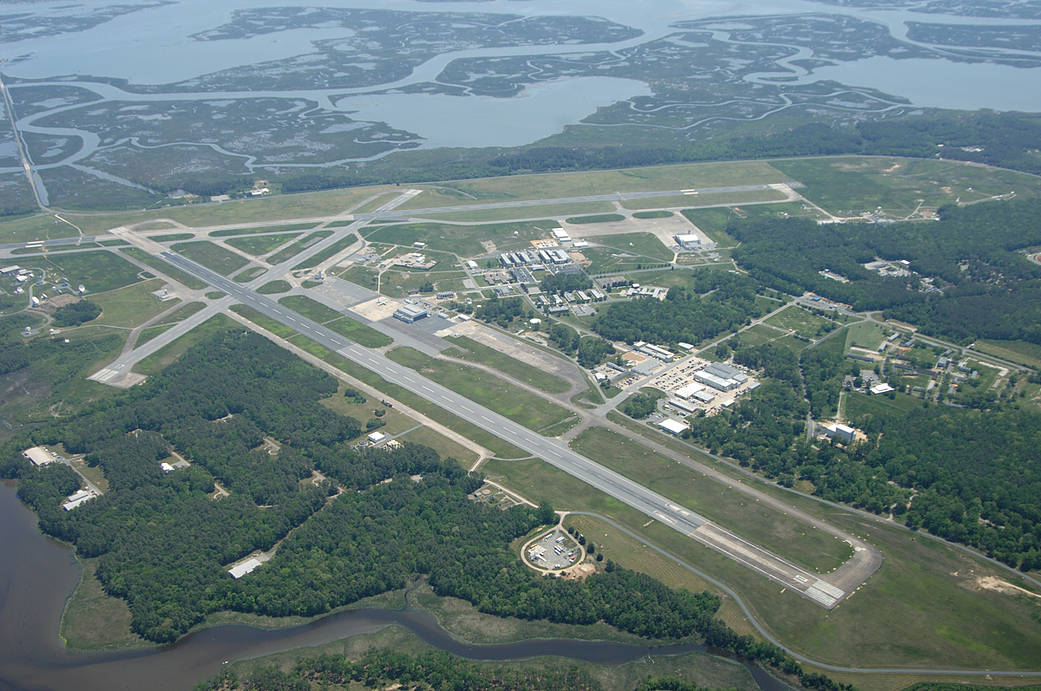
On May 8, NASA announced the appointment of Brian Hughes as the agency’s senior director of launch operations, based at the Kennedy Space Center (KSC) in Florida. “Hughes will have direct responsibility for launch operations at NASA Kennedy, as well as the agency’s Wallops Flight Facility (WFF) in Virginia,” said the announcement. WFF has been managed by Greenbelt’s Goddard Space Flight Center (GSFC) for more than four decades. Some speculated that Hughes might oversee it while it remained under the umbrella of GSFC, but on Friday, May 22, NASA Administrator Jared Isaacman announced a major reorganization plan that places WFF under KSC. While this might seem to be part of the recent shrinking of GSFC, in further changes, on May 5 the GSFC acting center director announced plans to increase hiring (see article page 7).
What Is Wallops?
NASA describes the origins of Wallops, which predates the agency, as follows: “In April 1945, NASA’s predecessor the National Advisory Committee for Aeronautics or NACA decided to set up a launch range on the small barrier island on Virginia’s Eastern Shore. … The facilities were sparse for these first launches. The launch area consisted of a 50- x 50-foot concrete slab as the launching platform; an 8- x 10-foot observation station covered with sandbags; a rocket motor storage igloo and a final loading building. … The work area consisted of five wooden shacks: an operations office; assembly shed; general warehouse shed; radio, dispensary and dark room shed; and a power generator house with a 15kw generator. Also, the living area consisted of tents with wooden floors. From these humble beginnings facilities have expanded to include government and commercial facilities with a value over $1 billion.” (See nasa.gov/wallops-history.)
In 1981 the Wallops facility was consolidated with GSFC. NASA described WFF as its primary facility for suborbital programs, supporting projects using scientific aircraft, balloons and sounding rockets.
Impact of Removal from GSFC
Keith Cowing of NASA Watch described the move of WFF supervision to Florida as “continuing the deliberate shrinkage of Goddard,” and a move to place management within “red” (Republican) states. Isaacman responded to Cowing on the social media platform X saying, “It just makes sense to have launch complexes, like KSC and Wallops, managed by a launch center instead of a science center.” However, most of the launches taking place from Wallops are for science and not human space flight for which KSC is known and is the hub for. In addition, Wallops is not the only other launch center in the U.S. that NASA uses, or even in Florida, for there are more in Cape Canaveral, as well as further afield like Vandenberg Space Force Base on the West Coast.
A civil servant at GSFC expressed concern to the News Review that the consolidation of launch services and moving the supervision of Wallops to Florida will present difficulty in securing infrastructure funds and future work priorities for the facility. He believes KSC has been trying to dismantle Wallops for decades. A NASA contractor told the News Review dismantling WFF would not surprise him due to the potential rivalry, with the KSC being the primary launch facility on the East Coast, where the space shuttle and all other U.S. human space flight launches have taken place.
Though WFF focuses on suborbital flight it is also home to Rocket Lab, which has used it for orbital satellite launches since 2023, and it has been a launch site for space station resupply since 2013, using the Antares rocket for orbital cargo missions there, the contractor noted. WFF will also be the primary launch facility for the larger Neutron rocket from Rocket Lab as early as 2027, which is a commercial, non-crew rocket, so there’s a growing commercial space flight component of WFF unrelated to human flight, said one aerospace engineer, who pointed to ways WFF didn’t fit into the human flight mission of KSC. He also noted the ease and affordability of getting to WFF from GSFC as opposed to KSC. The lack of compelling rationale for moving control of WFF and burying the news inside the Hughes appointment announcement supports the argument that this might be more deliberate shrinking of GSFC that aerospace engineer told the News Review a week ago. However, with Friday’s news of a large overall reorganization, he now hopes the Wallops decision is part of general reshuffling rather than targeting GSFC for reduction.
Another NASA source was more optimistic about what the reorganization signified for GSFC’s future. He told the News Review he heard the change was not about GSFC in particular, and believed it was more likely about consolidating launch services and Hughes’ domain.
GSFC is acting upon this month’s directive from Isaacman to restore and sustain NASA’s “core competencies” through a rapid hiring initiative to bring in a greater number of civil servants. So, the center may not be continuing its trajectory of dramatic reductions. However, following over a year of cuts and incentivized resignations and retirements, Goddard workers we spoke with expressed sadness at the loss of their connection to WFF and ongoing uncertainty about what the seemingly conflicting messages they’ve been receiving mean. For now, the constant remains change.