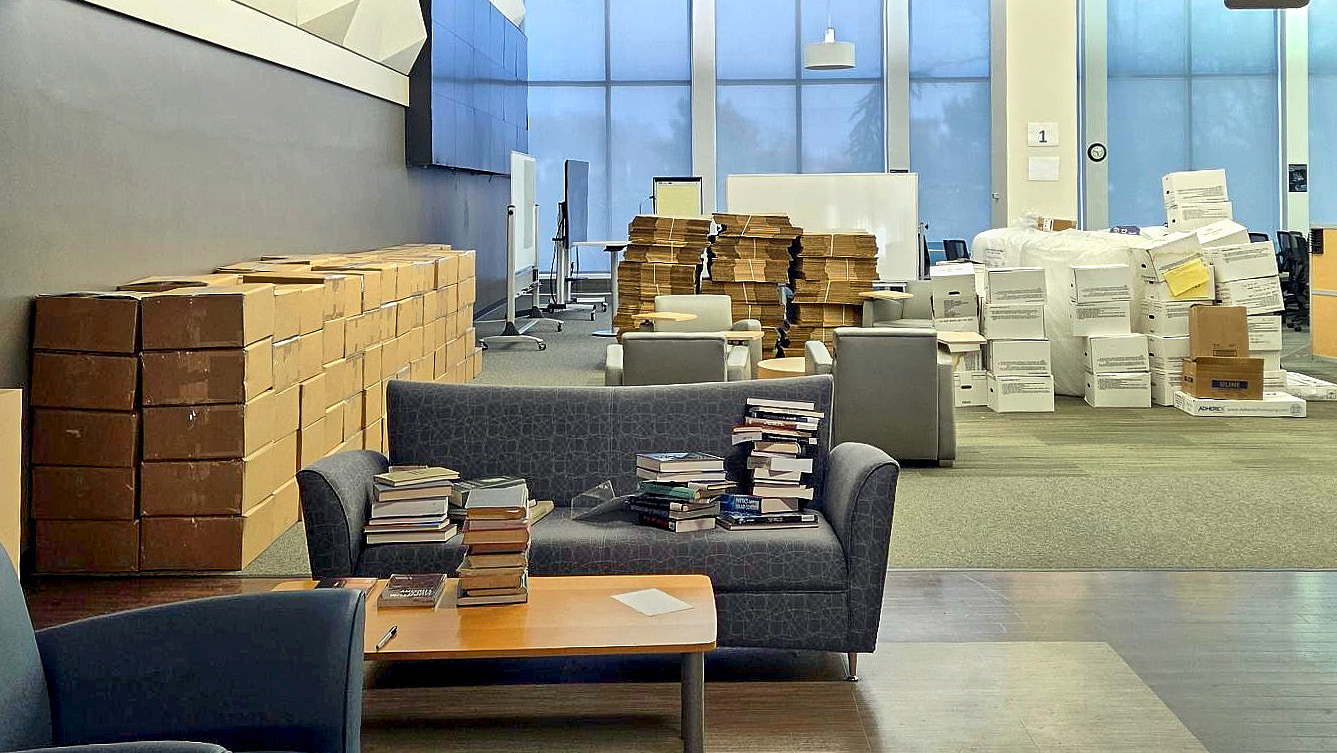
Goddard Space Flight Center (GSFC) was home to NASA’s largest research library. Then its services and operations were paused on December 9 for a 60-day review and less than half-way into that period, on January 2, the agency announced the library’s closure, shuttering the physical space (see the January 8 issue). The library closure is now the subject of a lawsuit and the divestment of its materials has been halted until April. The News Review spoke with Zachary Weil, a lawyer for the plaintiffs in the case.
One plaintiff, David Williams, is a recently retired planetary scientist. Another plaintiff, Giovanni de Amici, is a current employee working in observational astrophysics and cosmology and another plaintiff is the Goddard Engineers, Scientists and Technicians Association (GESTA) (Goddard’s union.)
“What the plaintiffs are really concerned about in this case is the opaqueness of the decision,” says Weil. “It’s not grounded in any sort of reasonable explanation that justifies the closure,” he alleges. Weil notes that in early January NASA Administrator Jared Isaacman said that the move is in keeping with the ongoing consolidation effort and the 20-year Master Plan begun in 2022. As the News Review has reported, that’s the document that has been pointed to as justification for expedited closures of buildings on the campus (see the September 24, 2025 issue). However, the Master Plan makes no reference to the permanent closure of Building 21, where the library was housed, nor to the closure of the library itself. In fact, far from being part of a long-term plan, the closure violates an agreement with GESTA to keep the library open. When NASA’s administration attempted to close the library before, in 2011, the move resulted in an Unfair Labor Practice Charge and the agreement with GESTA to maintain the library on the campus and give the union written notification of any proposed changes or decisions impacting the library. The Trump administration revoked recognition of the union on August 28 (see the September 3, 2025 issue) and the rapid closure of the library comes during what may be a temporary lapse in union recognition, which is its own legal battle.
NASA’s Largest Research Library
Prior to the rapid recent changes under the current administration, NASA’s commitment to maintain a library at Goddard created “concrete reliance” upon it for workers there, says Weil. “The workforce at NASA have a legitimate reason to rely on this promise to keep the library open indefinitely,” Weil told the News Review.
“Goddard was the largest research library in the entire agency. It had an estimated 100,000 volumes; and one of the reasons why it has become such an important focal point is because over the last decade NASA has been consolidating libraries at other facilities across the country,” said Weil. As the agency closed other libraries, such as the joint Army-NASA library in Huntsville, Ala., in 2019 and the library at NASA’s headquarters in 2024, important materials and records were sent to Goddard to preserve institutional knowledge and important resources. “This lifeboat, this sanctuary for all of those materials … is now suddenly closed. So, what happened to that promise [to preserve knowledge at Goddard]?” asks Weil. Weil says that due to the agency-wide significance of Goddard’s library, it holds importance not only for the workers who have come to seriously rely on it in their work but for the public interest. “This is the nation’s space agency; a civilian space agency, and one of the things it was tasked with when it was founded was to preserve and disseminate the institutional knowledge that it amassed and to make that readily available,” says Weil. “Is closing the library in keeping with those statutory obligations?” he asks.
Record Retention
Weil says the federal record retention schedule changed in September 2025 and “materially departs” from how it had been for decades. Any time a federal agency wants to dispose of a record classified as a federal record under the Federal Records Act of 1950, it has to go through a scheduling process that involves sorting and approval by the National Archives, explained Weil. “Some of the things we’re really concerned about are the elimination of certain safeguards that actually make it easier for NASA, on its own, to schedule and dispose of records without previous types of oversight, that includes getting the approval of the archivist, when it comes to records and materials that could have permanent status under the Federal Records Act. And that’s very alarming because we have to ask ourselves what was the reason behind materially altering the record retention schedule in this way and why does this happen in early September and then weeks later does all of this very quick and opaque action begin to occur at the Goddard Space Flight Center.” We ought to ask if it is truly necessary to dismantle the library, said Weil and if it is then surely it can be done in a way that properly sorts, categorizes and protects materials with impermanent or permanent status, he argues. “But why this speed and why this opaqueness? Why are we not able to get answers to simple questions?”
As we reported in the February 18 issue, trucks began removing materials from Goddard’s library on a Saturday afternoon last month. “It is disappointing and it is disturbing,” said Weil. “If everything NASA is saying can be taken at face value and trusted, then why the secrecy and why the abruptness? Why create a 60-day review process and conduct it in a manner that allows little or no transparency?”
What Remains at the Library
On February 27 there was a hearing for a temporary promise made to the court to halt further dismantling of the library. “Government has made assurances that everything stays where it is,” said Weil of a restraining order that should prevent the removal of materials from the library until April 30. However, the government argued that federal records should continue to be shipped to NASA’s Glenn Research Center in Ohio and the court allowed for those materials to continue to be sent.
“We’re not looking at this in a vacuum,” explained Weil, who pointed to what happened at Goddard’s annex at Columbia University, the Goddard Institute for Space Studies, which “virtually closed down overnight,” said Weil, when the lease was terminated and the facility shuttered in May 2025. The personal possessions of workers were literally put on the curb in some cases, said Weil. The News Review has reported on concerns about personal and professional property at Goddard, where buildings have been closed with little notice to their occupants of where or when they’ll be moving (see the November 6, 2025 issue). Thus the plaintiffs sought to cease the movement of materials and prevent irreparable damage being done before the case can be heard. “The administration, NASA leadership, management at Goddard can say one thing but over the last year, repeatedly, the actions that have been committed give the plaintiffs every reason to suspect that NASA is not conducting itself … in good faith. How can you say on one hand that the employees of Goddard have nothing to worry about when back in September they are closing down laboratories and in some cases throwing away personal effects, leaving personal items on the curb. What reason do these individuals who have dedicated their professional lives to this agency, as public servants, what reason do they have to believe that now this library closure will be conducted in any manner that’s different from the way that they’ve been conducting themselves to date?” asked Weil.
Asked what outcome the plaintiffs are looking for in the case, Weil said “the plaintiffs want the dismantling to stop and they believe they have a case.” “There’s a lot of precedent to suggest that what the administration is doing is improper,” he told the News Review.
Lack of Rationale
“It all goes back to this question of ‘Why?’” said Weil. “What’s missing is a legitimate explanation.” They haven’t been given answers to their questions but redirected to the Master Plan, which doesn’t speak to the library’s closure, said Weil. There’s “no explanation grounded in anything concrete that justified it,” he told the News Review. Rather, its closure is another step in the effort to continue dismantling these research facilities, Weil said.
“Agencies have a lot of discretion to do a great many things, especially when it comes to internal management … even when it comes to making massive policy changes,” noted Weil. “Really the only thing they have to do is point to a reason and have that reason be grounded in something and the courts have said time and again, ‘we’ll leave it alone, even if they disagree with it, we’ll leave it alone,’ but they still have to show a reason. And they haven’t done that here. And that’s why I believe the plaintiffs have a case,” he told the News Review.
The News Review reached out to NASA Goddard to ask about the rationale behind the library’s closure and the speed at which it was being conducted. The Office of Communications directed us to NASA Headquarters, which was initially responsive, requesting our deadline and saying they’d be in touch. However, the statement they later provided was, “For matters in litigation, please contact the U.S. Department of Justice.”