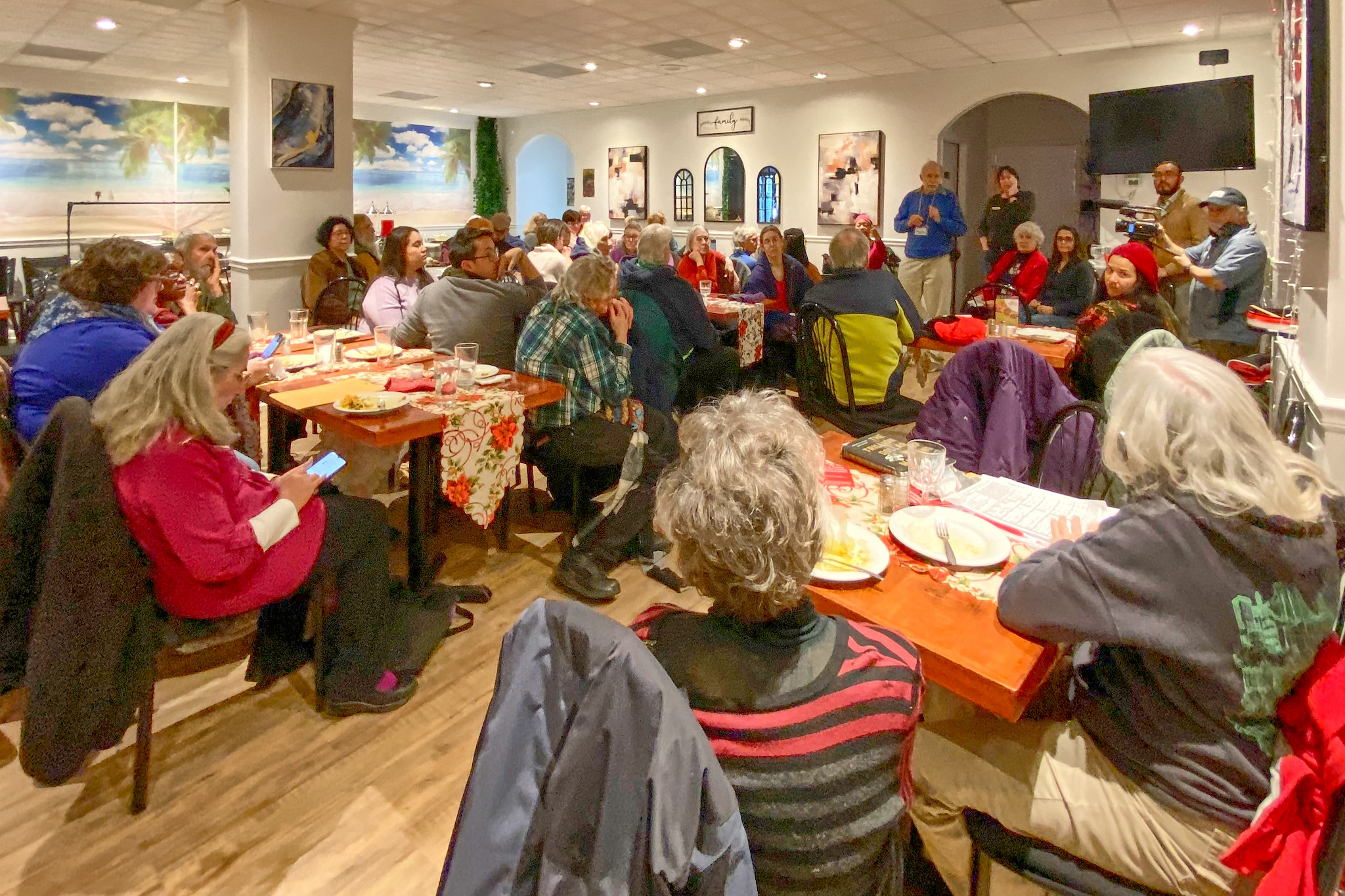
A receptive crowd of approximately 40 Greenbelt Homes Inc. (GHI) court liaisons and others gathered at Sunrise Caribbean Restaurant on the evening of Tuesday, December 30 to prepare for the Save As You Throw trash collection pilot which began Monday, January 5. Greenbelt Advisory Committee on Environmental Sustainability (Green ACES) Chair John Lippert said the evening’s focus was on complex issues not previously discussed.
Attendees included court liaisons; Lippert and other Green ACES and Green Team members; city staff including City Manager Josué Salmerón, Sustainability Coordinator Luisa Robles and Constituent Services Coordinator Gizelle Alvarez; and City Councilmembers Kristin Weaver, Jenni Pompi and Frankie Fritz.
Setting the Scene
The event began with a buffet meal, during which attendees chatted about trash, recycling and composting among themselves and their courts. Court liaisons share information, help with problems and foster community among GHI neighbors. (The court liaison program restarted in 2025.)
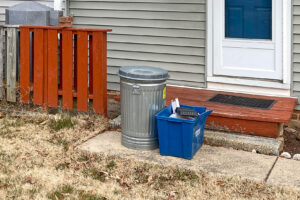
Some of the issues discussed arise from how a new city trash collection rule intersects with an existing GHI trash storage rule. GHI requires storing cans in closets or enclosures. Beginning this month, city waste collectors will no longer remove trash from those spaces, instead requiring GHI residents to move trash to a visible location for collection, and newly enforcing an existing city rule to place trash bags in tightly-lidded cans. Some GHI residents aren’t physically capable of moving cans from closets/enclosures, and some GHI residents who didn’t previously use cans must purchase cans.
Challenging Trash Enclosures
Court liaison Jan Wolf and Green Team member Susan Barnett mentioned enclosures whose design allows trash can removal only by lifting straight up, instead of safe lifting by squatting to reduce the risk of back injury.
Robles acknowledged the issue, saying she was aware of only two such enclosures within GHI. Robles said the city will work with residents with such enclosures. There is an on-premises collection request form on the SAYT webpage. (See box.)
Exemptions
Court liaison and News Review member Carol Griffith asked about the status of on-premises collection requests from residents. (Residents physically unable to remove cans from GHI enclosures or closets, or to single family home curbs, may request an exemption from doing so.) Robles said she was currently aware of five requests, two of which were ineligible because one contained no justification and the other had a household member able to move the can.
Residents don’t have to describe their limitation, but they do need to attest to a physical limitation preventing them from placing trash and recycling outside enclosures/closets or at single family home curbs. They must also attest there is no other physically capable person in the household, and provide copies of the requestor’s ID, and either their handicapped parking tag or a physician’s note confirming the limitation. They can provide these items via the SAYT webpage form, or in person at Public Works or by mailing them there. Robles said she has printed and taken forms to residents without computers.
Those with a temporary physical limitation, such as after surgery, may also request on-premises collection, said Weaver.
Disabled, Other
Lore Rosenthal said she is coordinating with the Golden Age Club and the Greenbelt Intergenerational Volunteer Exchange Service (GIVES) to provide information and support for members to integrate SAYT with independent living in their own homes.
Court liaison Diana Rutherford suggested large print versions of the city flyers that review what items are and are not recyclable or compostable, because every resident may not be able to use city webpages with the flyers. Robles planned to act on the suggestion. (See box.)
Several attendees raised the sensitive issue of residents with memory challenges who may find it difficult to follow SAYT rules. Rosenthal said Max Trash stickers may be a simple approach for some to begin with. Another concern was people working to address hoarding by removing many bags of items from homes. In response, some suggested using bulk trash or taking bags to workplaces ‒ if the workplace allows that.
Salmerón emphasized the availability of city services to help residents with dementia, hoarding and other challenges, including helping disabled and elderly residents stay in their homes. Alvarez can connect residents to city staff from Greenbelt Assistance in Living (GAIL) and CARES, who can partner with residents, families, court liaisons and neighbors. (See box.)
Cans to Fit Trash Closets
Among GHI residents purchasing trash cans for the first time, some with smaller trash closets are having difficulty finding small enough cans. Salmerón told attendees the city will purchase cans in bulk for small closets, after determining the correct size and needed quantity. He asked GHI residents with smaller closets to provide their closet width and depth, name, address and contact information to Robles and Alvarez. Wolf suggested that smaller hardware stores such as Ace and Strosnider’s may have more choices than big box stores or online vendors.
Multifamily Homes
Bob Cahalan spoke about choosing between SAYT bags or Max Trash stickers in multifamily households, such as where parents live on one floor and an adult child’s family on another. Assuming such homes receive one trash bill, and are thus eligible for one Max Trash sticker and up to 99 gallons of trash weekly, Lippert said using SAYT bags would be best. This allows each family to choose how to pay for the trash they produce.
Ask for Help Soon
During the SAYT pilot’s first two weeks, January 5 to 17, residents can familiarize themselves with its operation without penalty. In the first week, households using neither SAYT bags nor Max Trash stickers will receive a warning notice and their trash will be collected. If the behavior recurs in the second week, the household will receive a warning notice and their trash will not be collected. In the third week, warning notices will change to fines and trash will not be collected.
Robles encourages households with particular challenges to contact the city as soon as possible, especially during the first two weeks. She told the News Review that Public Works is available to make site visits to help residents devise solutions, whether for a problem enclosure, physical limitations or how to recycle more. She advised contacting Public Works Director Brian Kim, Refuse/Recycling Supervisor Michael Barnes and herself. (See box.)