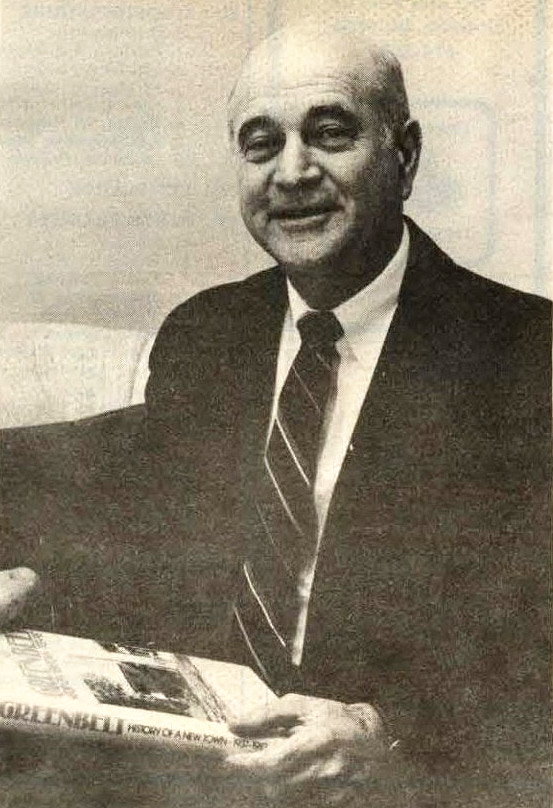
This is Part 1 of a two-part series remembering Former Mayor of Greenbelt Gil Weidenfeld. This first article focuses on an interview with his daughter.
When Sharon Weidenfeld Robinson thinks of her father, she remembers the day he stood before a heckling crowd in the Greenbelt City Council chambers, reading from the Supreme Court’s landmark Brown v. Board of Education decision as residents booed and walked out. In 1972, while many in the audience urged city leaders to oppose a federal school desegregation order, Gil Weidenfeld argued Greenbelt should follow the law. Despite the opposition, he continued reading, and by the end of the meeting, the council voted not to oppose the desegregation order (See the December 21, 1972 and January 11, 1973 issues for the council’s discussions of busing in Prince George’s County to achieve racial balance in schools).
“I was a little kid, and I was like really impressed,” said Robinson, who was in the crowd that day. “I think that really stuck in my head to see him stand up for civil rights in that way, and to be able to withstand the booing.”
Weidenfeld, who spent 22 years on the Greenbelt City Council, including 14 years as mayor, died on July 4, 2026, at the age of 93. He is remembered for the courage he displayed in the council room in 1972, as well as the years of service and dedication he devoted to the City of Greenbelt.
Weidenfeld, a first-generation American, was born in the Bronx, N.Y., in 1932, before moving to a chicken farm in New Jersey at a young age, where he later met his future wife, Muriel “Micki”. After marrying and having two daughters, Sharon and Ellen, they moved to Greenbelt in 1965. Robinson recalled a “normal family life in Greenbelt,” frequent trips to New Jersey and her father’s generous and caring nature. Weidenfeld was married to his wife for 71 years, until her death in 2024.
“He was friendly to everybody,” Robinson said. “He wanted to hear what was going on in people’s lives, and just tried to make everybody comfortable around him. He was the type of person that if we had more people like him in this world it would be a lot friendlier of a place.”
When speaking to the News Review, his daughter recalled stories that truly encapsulated her father’s spirit. She remembered him leaving his family just before the Fourth of July fireworks to help a lost child find his parents and volunteering to escort a Miss Greenbelt contestant who did not have a partner for an event.
Robinson said her father’s kindness and compassion were reflected in his years of public service. During his time on the Greenbelt City Council, Weidenfeld helped bring Green Ridge House — a city-owned apartment community that provides housing and support services for residents 62 and older — to fruition. He also played a key role in establishing the Greenbelt Aquatic & Fitness Center.
“Those are two of the things that really meant a lot to him, and I think that they’re really good things that the city has,” Robinson said.
Beyond Greenbelt, Weidenfeld was also a past president of the Prince George’s Municipal League, a Hall of Fame Inductee for his efforts with the Maryland Municipal League and a past chairman of the Metropolitan Washington Council of Governments.
Robinson emphasized her father’s selflessness when it came to public service.
“He wasn’t in it for personal gain … He genuinely loved the city of Greenbelt and the people in Greenbelt,” she said.
Weidenfeld had not planned on being involved in local politics. However, after moving to the Springhill Lake apartment community, he wanted to ensure that everybody in his neighborhood was properly represented, according to his daughter. In a News Review interview in 1994, he indicated that he ran for the city council in 1971 because he wanted a community center for Springhill Lake.
“He probably had a more liberal outlook on things than some of the other people on the city council at the time. He felt that he could bring some of his knowledge [from] his experiences in life and his ideas of how things should operate to the city,” Robinson said.
As the mayor of Greenbelt, Weidenfeld treated his constituents with respect and an open mind, according to his daughter. She said he prioritized listening to residents’ concerns, and said her father believed effective public service meant seeking to understand differing viewpoints, even when he disagreed.
Weidenfeld died at his home in Annapolis, surrounded by his family. He is survived by his daughter Sharon and her husband Garnett; his daughter Ellen Vesey, her former husband, Mike, her son Justin (Yeimi) and her daughters, Jordan and Jillian.
Charlotte Ormond is a University of Maryland student at the Philip Merrill College of Journalism interning with the Greenbelt News Review.