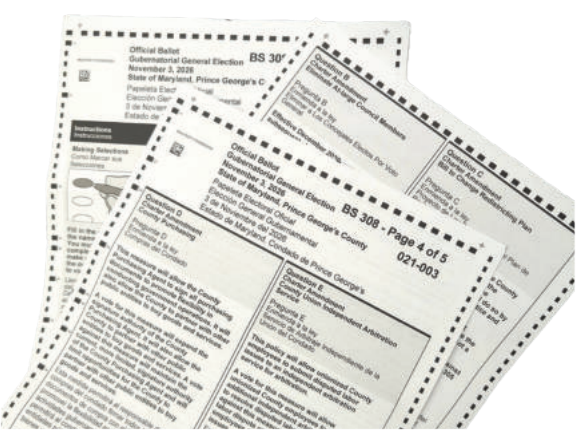
This November there will be 10 questions from the county on the ballot for voters to consider. Five are charter amendments that range from “harmful business” taxes on liquor stores and self-storage units, for example, to eliminating at-large county council members, to redistricting, purchasing and arbitration. A further five deal with bond issues and will be addressed in a subsequent article.
A. Charter Amendment: Harmful Businesses Taxes and Fees
The first question seeks to allow Prince George’s County to impose additional taxes and fees on businesses “deemed to have an adverse impact on community health, safety and welfare or county economic development,” such as tobacco and liquor stores and self-storage units. A vote in favor will allow the county to impose taxes and fees on “operators of businesses that negatively impact the quality-of-life of county residents or economic development” and remove the current requirement that the public vote on them directly.
Relevant context for this question is that in the spring the county council in a 9 to 2 vote passed a new $5,000 annual fee on the owners of liquor stores, tobacco stores, gun stores and consolidated storage businesses. At-Large Member Jolene Ivey and District 9 Member Sydney Harrison were the two opposed, citing legal and other concerns. County Executive Aisha Braveboy did not sign the legislation but said she would not veto it because it passed by supermajority in the council. The county is now being sued by a group of business owners over the new fee, which they say is a tax the county isn’t authorized to impose. Greenway Liquors in Greenbelt is one of the 50 plaintiffs.
The county’s current charter requires voter approval for raising most taxes and certain fees. If passed, the question on the ballot “will allow the county to impose taxes and fees, to the extent authorized by law, on operators of businesses that negatively impact the quality-of-life of county residents or economic development.”
Even if the charter is changed to allow the county to tax businesses that negatively “impact quality of life” without going back to voters, it will continue to face state constraints. Currently, the Maryland General Assembly must approve new non-property taxes and most increases to them. However, greater county authority may be coming as Maryland county executives are seeking greater, more devolved taxation powers and a taskforce ‒ the Task Force to Modernize County and Municipal Revenue Structures ‒ led by Comptroller Brooke Lierman is currently evaluating county revenue generation and authority. That taskforce’s recommendations are due to the governor and senate committees by December 1.
B. Charter Amendment: Eliminate At-Large Council Members
This amendment would eliminate the two at-large county council positions effective December 2030, reducing the number of county council members from 11 members to nine. The measure is billed as increasing efficiency and cost-effectiveness and “restor[ing] the voting strength of communities and neighborhoods in each district.” It states an aim to eliminate the cost for general and special elections for those seats and compensation for those two offices.
In the May 13 issue we reported the history of the at-large seats, which were created in 2018, following a 2016 ballot measure. The seats have been criticized as benefiting candidates who wish to circumvent term limits or use them as stepping stones to higher office (see the May 13 issue for more). Proponents of the seats see them as providing a countywide perspective and advocacy broader than the representatives of individual districts. Ivey, in particular, has argued that the at-large seats give residents more options, in effect, three representatives to turn to.
C. Charter Amendment: Bill To Change Redistricting Plan
This measure would require that the county council make any changes to the redistricting plan proposed by the county Redistricting Commission by a bill rather than a resolution.
The Redistricting Commission establishes council districts and oversees any redrawing of districts every 10 years, following the census. Currently changes can be made by a resolution followed by a public hearing. In 2021, the county council altered the map put forward by the Redistricting Commission but that move and the resultant map were found unlawful by a lower court and subsequently Maryland’s highest court, the Court of Appeals (now called the Supreme Court). In Charter for Prince George’s County v. Thurston, an attorney for residents in the case argued map changes via resolution circumvented the county executive’s ability to veto them, among other things. This question amends the charter to reflect the 2022 court ruling that redistricting requires a bill and cannot be done by resolution.
D. Charter Amendment: County Purchasing
The fourth measure on the ballot would allow the county Purchasing Agent to sign all purchasing documents “to promote flexibility in conducting government operations” and to “partner with other public entities to buy goods and services.” The County Purchasing Agent is the Director of the Office of Procurement. A review of proposed changes to the text of the charter show they include changing “The duties of the County Purchasing Agent shall include responsibility for …” to “The duties of the County Purchasing Agent shall include full signature authority to execute all contracts, agreements, and purchase orders as well as responsibility for …” The measure summary said it will “expand the signature authority of the County Purchasing Agent.” However, Braveboy’s Executive Order 44-2025 already granted “full authority to the Director of the Office of Procurements to sign contracts and purchase orders.” Thus, the summarized change given in the ballot measure seems to reflect what is already in place though not yet written into the charter, and thus subject to being changed by a subsequent executive order. At a May county council meeting the benefit of the measure was said to be expediency.
Other changes to the charter language remove a segment about the sale and disposition of surplus, old and waste supplies and materials or their transfer.
The measure also changes one of the stated duties of the Purchasing Agent from conducting “programs involving joint or cooperative purchasing with other public jurisdictions” to “with other public entities.” The terms are not defined but jurisdictions would seem to relate to municipal, state or federal governments or areas governed by them while “entities” is much broader and might include corporate bodies. The summary states the measure will “allow the county to partner with other public entities to buy goods and services” rather than “limit[ing] that opportunity.”
E. Charter Amendment: County Union Independent Arbitration Service
The summary states, “This policy will allow unionized county employees to submit disputed labor issues to an independent arbitration service for arbitration. A vote for this measure will allow unionized county employees to use an additional independent arbitration service to resolve disputed labor issues.” A look at the text of the proposed changes shows a far more limited impact than implied by “unionized county employees,” as it will cover only “protective Service employees” such as police, firefighters and corrections officers. It will apply only if no contract is reached by March 1 of the year an old contract is expiring.
The change adds the option of federal mediation; for where the charter currently states disputed issues will be submitted to the American Arbitration Association this adds the additional option and alternative of using the Federal Mediation and Conciliation Service.
A second change to the text under this section removes the requirement that disputes be arbitrated according to the rules of the American Arbitration Association and replaces that with “pursuant to the Labor Code.”
At a May county council meeting Councilmember Eric Olson said the changes are to comply with labor law.
The News Review wondered how bringing arbitration under the county’s labor code instead of the American Arbitration Association would align with the independent nature of the arbitration service. We also would like to know who gets to choose if arbitration or mediation is utilized, and does that decision need to be agreed to by all parties.
The New Review’s calls to the county council to ask questions about the ballot questions were transferred to the Board of Elections, which only prints the ballot questions and can’t interpret them, but directed us to the Office of Law. The Office of Law directed our enquiries to the Office of Communications, where we left two voicemails and received no response by press time.
October 13 Deadline for Online Or Mail Voter Registration
Tuesday, October 13 is the last day to register to vote using online registration. Mail-in registrations must be postmarked on or before October 13.
Where to Register
Register to vote through online registration here: voterservices.elections.maryland.gov/OnlineVoterRegistration/InstructionsStep1
Download an application and find instructions on registering by mail here: elections.maryland.gov/voter_registration/application.html
Not sure if you’re registered? Review voter information here: voterservices.elections.maryland.gov/VoterSearch
You can also register to vote during early voting or on Election Day. Residents can go to an early voting center in the county during early voting or their assigned election-day polling place and bring a document proving where they live. Valid proof of residence includes an MVA-issued license, ID card, change of address card or a paycheck, bank statement, utility bill or other government document showing name and address.