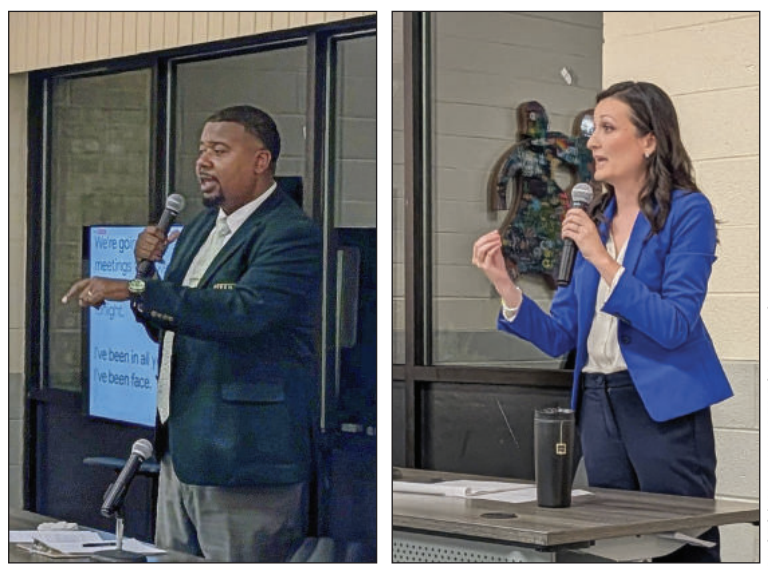
The two candidates running for the Prince George’s County School Board District 2 seat, Terence Clegg and Caroline Decaire-Goldin, came together on the evening of Thursday, October 15 for a packed public forum at Springhill Lake Recreation Center hosted by the Greenbelt Advisory Committee on Education (ACE) and the Greenbelt News Review. It was the first and only forum for the Board of Education candidates to be held in the district.
The candidates are hoping to fill the District 2 spot which has been empty since late June after board member Jonathan Briggs suddenly resigned. The spot is still vacant after the county executive failed to appoint an interim representative (see the October 1 issue).
Clegg, a Greenbelt resident, has spent more than 20 years working with children and families through nonprofit leadership and public service. For the past seven years he has worked in the Maryland Department of Human Services in an operations role, and he is the father of three children in Prince George’s County Public Schools.
Decaire-Goldin is a Riverdale resident with more than 15 years of experience in education across the region. She is currently the director of teaching and learning at the D.C. State Education Agency, but worked as a teacher at Thomas S. Stone Elementary in Mount Rainier and later as a STEM instructional coach at Hollywood Elementary in College Park.
(For more on the Board of Education candidates see the June 11 issue.)
The forum, moderated by ACE Chair Janet Mirsky, began with a series of pre-selected questions from the many that had been submitted in advance to ACE and the News Review. There were then questions from members of Greenbelt’s Youth Advisory Committee and audience members in the room.
Transportation
One of the most pressing questions of the night was about transportation. After the school year started with approximately 10,000 county students without bus assignments, candidates were quick to articulate their visions.
Decaire-Goldin said that she would like to see more transparent bus routes that are created a month before they start running and made public to the community to receive input from families. Overall, she hopes to see stronger communication between families and the board.
“I would like to actually hear the hard questions being asked because that’s what I deal with in my day-to-day work on an education policy side,” said Decaire-Goldin.
Clegg said that his current operations role has given him experience working with large fleets of vehicles and has taught him that by the time a problem occurs, it’s already a failure. He would like to see more planning ahead, more feedback loops and action items.
“We’ve got to move the ball forward every month until every kid is routed, until we fix this transportation issue,” said Clegg.
Supporting Teachers
Candidates were asked about ways they could better support teachers. Clegg said that Decaire-Goldin is not the only one who has classroom experience; he served as a substitute teacher, something he hadn’t previously shared during his campaign, and he had viewed first-hand the environment that teachers work in.
Clegg said that the county needs to hire enough teachers to meet students where they are and prioritize retaining those teachers to keep them in the county.
“You can’t know what it means to be a teacher unless you’ve done it,” Decaire-Goldin said after Clegg finished his response.
Decaire-Goldin detailed many of the struggles that she faced as a teacher in Prince George’s County, especially with facilities that lack resources like updated HVAC, pest control and modern infrastructure. She said that retaining and developing teachers is about funding and having the money to recruit and sustain them.
She also mentioned things that she said are often overlooked, like awkward credentialing systems that can force teachers out of the county and the impact of the Covid-19 pandemic on educators’ and students’ mental health.
“We have to help support, reskill and retool our teachers,” Decaire-Goldin said. “[We have to] make sure we have mental health resources and those tools will get us to retain and support them.”
School Funding
Another question organizers posed was how candidates would ensure the district adopts timely, realistic budgets, spends responsibly, issues contracts on time and helps schools secure all eligible funding through effective family outreach and required paperwork. This question came following a belated budget from the superintendent this year which came at the end of January, in violation of board policy requiring it by the end of the prior calendar year (see the February 12 issue) and against the backdrop of Hollywood Elementary’s recent loss of Title 1 funding, to which one resident suggested incomplete meal-benefit forms could have contributed.
Having previously worked in a Title 1 school, Decaire-Goldin said that she knows how “devastating” it is to lose funding for certain resources. She said that the budget situation is opaque and that people don’t get information in a timely manner. To fix this, she said that board members and administrators need to lean into communication to make sure families know what’s coming.
Clegg said that cuts are necessary to manage the budget, but shouldn’t be done without community input. He suggested that before cuts are made, the board should discuss them with the county council and state legislature, with the goal of advocating for fully funding education reform.
“I will always protect our educators and protect our kids,” he said. “Anything that is cut will have to come from above the classroom.”
He said that services provided in the classroom should be continued but things like technology services should be reevaluated to ensure schools only have the services that the community needs.
Based on school board candidate interviews conducted by the Local News Network, this week Capital News Service’s Mayah Nachman reported that “nearly halfway into the 10-year-long, $30 billion plan to establish a ‘world-class education system’ in Maryland [the Blueprint], many candidates are concerned about its feasibility.” The University of Maryland-based network reported 62 out of 70 school board candidates surveyed expressed concern about the financial and administrative implications of the plan. However, Decaire-Goldin and Clegg were in agreement as to the importance of the Blueprint, both calling for it to be fully funded.
Audience Questions
The second part of the forum saw the candidates field questions from residents in attendance. Two students jointly representing the Greenbelt Youth Advisory Committee asked two questions. First, they expressed concern about their curriculums not including practical areas to explore.
In response, Clegg noted how his children have participated in walking field trips to learn more about nature in the county, while Decaire-Goldin recalled students she taught participating in a gun violence protest and other experiential offerings.
Second, the youth wanted to understand the candidates’ stances on proposed “bell-to-bell” cellphone bans, saying that with many websites blocked on computers, students often need to use their phones for research projects.
Despite the candidates sharing relatively similar sentiments for most of the night, this issue presented a stark contrast in viewpoints. Decaire-Goldin answered first, suggesting an overall scan of the need for phones in lesson planning. Clegg followed, and he explicitly supported the ban.
“As parents, we have to walk a narrow line,” said Clegg. “Make sure that you have the resources that you need, but also make sure that we’re keeping you safe at all times. There’s so many outside influences on the phone. … We want to make sure you guys are focused on learning during the day.”
After the youth asked their questions, parents asked how disparities between schools could be improved in materials and infrastructure. Both candidates continued to promote equity, saying that they would make sure everyone had a voice in each issue that was brought up.
Responding to a question about the lack of books in county schools, which followed one about restrictions on technology, Clegg continued to promote equitable and balanced practices to involve more hard copies of materials in learning, and Decaire-Goldin also showed her support for revitalizing books in classrooms, noting experience with books that didn’t get used.
“Telling a student you have to have access to technology for everything they need is inequitable,” Decaire-Goldin said. “Not all families have access to a computer. Not all families have access to a phone that stays on all the time.”
Candidates also discussed infrastructure issues in some schools, such as HVAC malfunctions, electrical fires, and at times, a lack of clean drinking water. Both Decaire-Goldin and Clegg support direct conversation with parents, teachers and students to advocate for the specific issues they see that may prohibit learning.
The final question both candidates answered requested their top priorities if they were elected. Clegg established his intent to revamp the transportation system, create periodic meetings to stay face to face in the community and make sure every school had a Parent Teacher Association or Organization. Decaire-Goldin distilled her philosophy to three points — transparency, community and rebuilding trust.
For a district that’s been without representation since June, the forum served as a chance for residents to inform their upcoming decision, said Denna Lambert, a member of ACE and one of the event’s organizers.
“My hope is that [the forum] sends a signal to the community that we can have dialogue about specific questions,” Lambert said. “But it also sends a message to the candidates that we have an engaged and involved community of parents, teachers [and] youth.”
Voters will have the chance to choose between Decaire-Goldin and Clegg in the general election. The winner will start their term on December 7 and serve for the next four years.
“Between now and November 3, I would tell people to do their research,” said Lambert. “Get out there and vote, bring a friend to go vote and continue the involvement beyond Election Day!”
Residents who were unable to attend the forum in person can view a recording by Greenbelt Access Television (GATe) at youtu.be/f7ASyDaKvQU.
Lillian Gray and Peter Kelly are students at the Philip Merrill College of Journalism writing for the Greenbelt News Review.