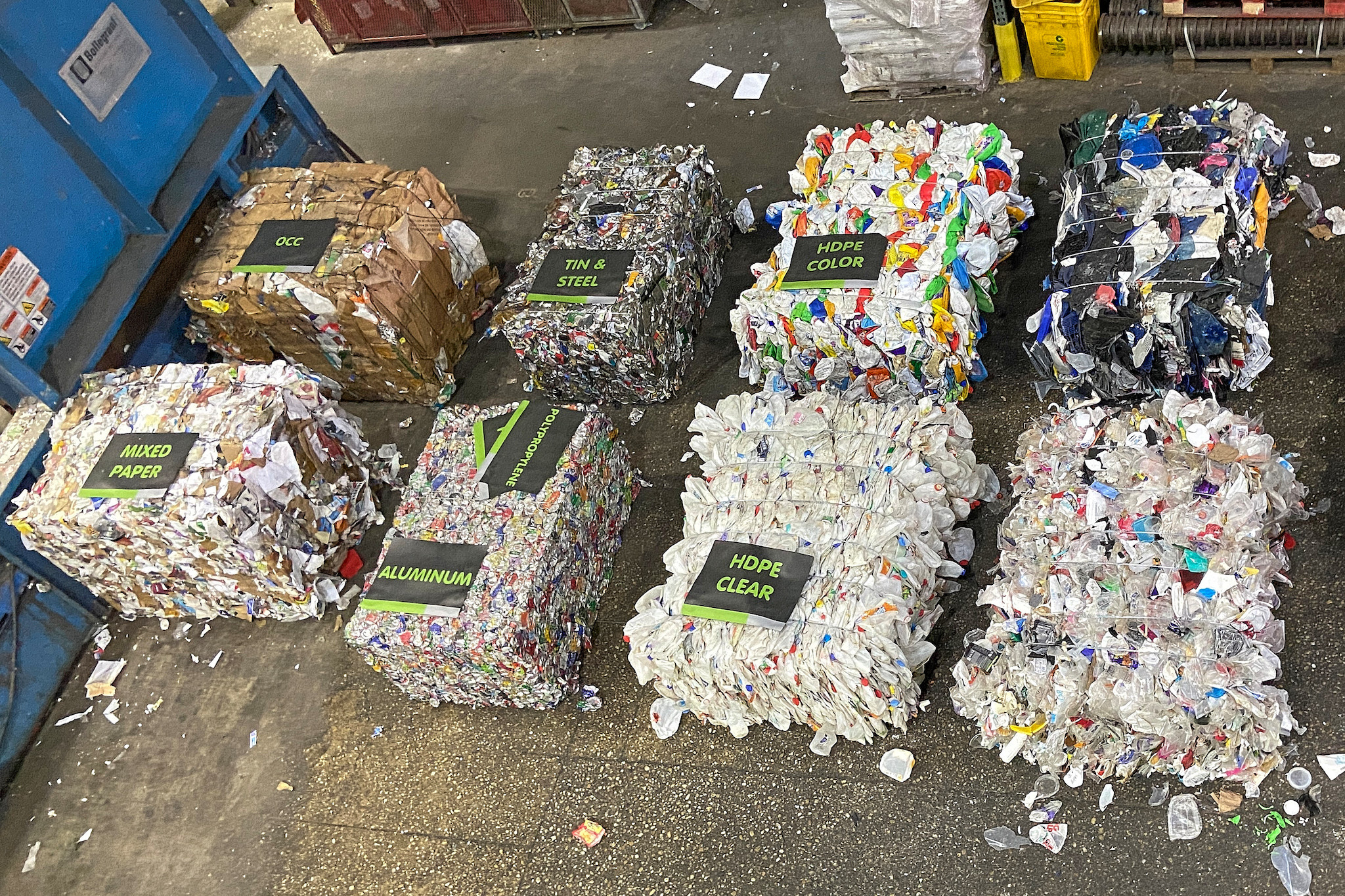
The good news is, #7 plastics can be recycled in Greenbelt; the bad news is, those small single serving coffee pods cannot, nor can chip or snack bags, wire coat hangers or metal wreath frames. But a surprising number of other everyday items can be placed in residents’ recycling bins curbside or in the city’s collection containers around town and may eventually see new life as fabrics, flooring, insulation and more, thanks in part to significant upgrades at the Prince George’s County Materials Recycling Facility (MRF) in Capitol Heights, where the city takes its recycling.
The MRF
The nearly eight-story tall facility, which sorts, separates and bales Greenbelt’s recycled matter, has seen a 90 percent upgrade to its equipment since 2021, said Michael Bell, senior lead operations manager. The county has spent $7 million on the plant in the last five years, and will spend another $2 million this year, to include enhancing a live-feed camera system, he said.
The facility was built in 1993 and was previously operated by Waste Management, Inc. Since 2015 it has been operated by Maryland Environmental Service (MES), the nonprofit state business established by the General Assembly in 1970 for operational and technical services to protect Maryland’s environment. MES operates more than 1,000 projects throughout the state, along with recycling and composting facilities and landfill sites such as the Brown Station Road Sanitary Landfill and the Prince George’s County Yard Waste Composting Facility, both in Upper Marlboro.
GHI Tour
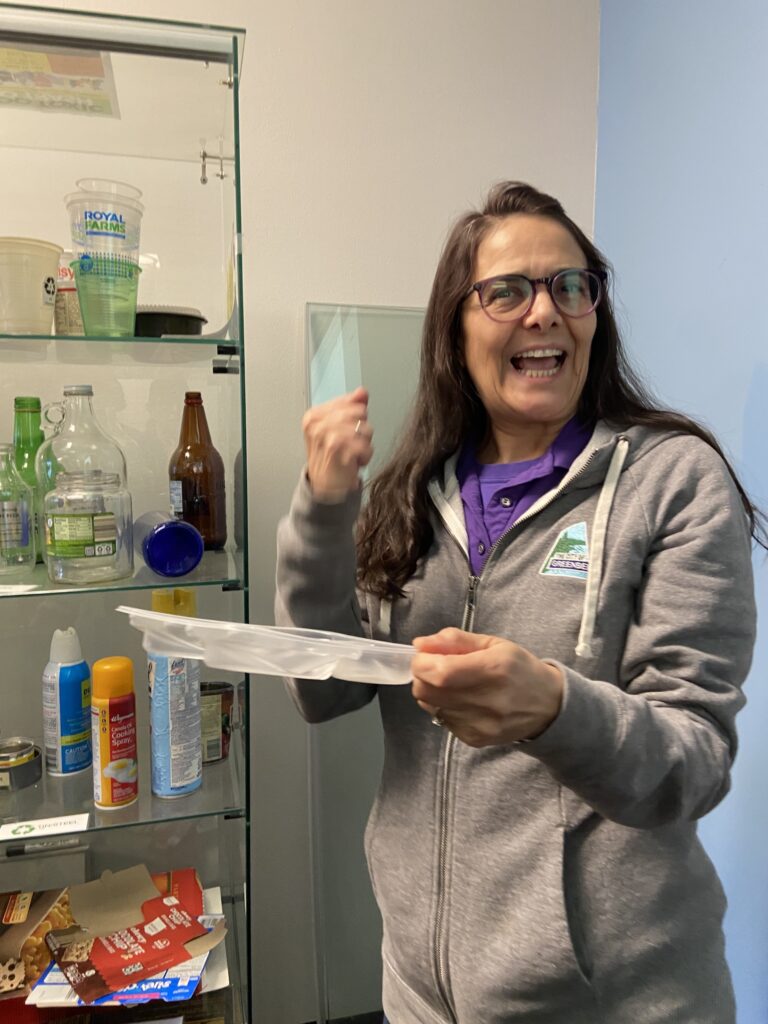
A group of volunteer court liaisons from Greenbelt Homes Inc. (GHI) recently toured the plant and witnessed a mind-blowingly complex labyrinth of crisscrossed and overlapping conveyor belts that feed all the bottles, cans and paper through magnetic, air and optical sorters, in an order designed to separate the materials into useable ingredients like polyvinyl chloride (PVC) or paper for pulp, which are then baled and sold by bid on a monthly basis. The plant processes 250 tons daily (a weight equivalent of 40 to 50 elephants), and more over the Christmas holiday season, Bell said.
The Process
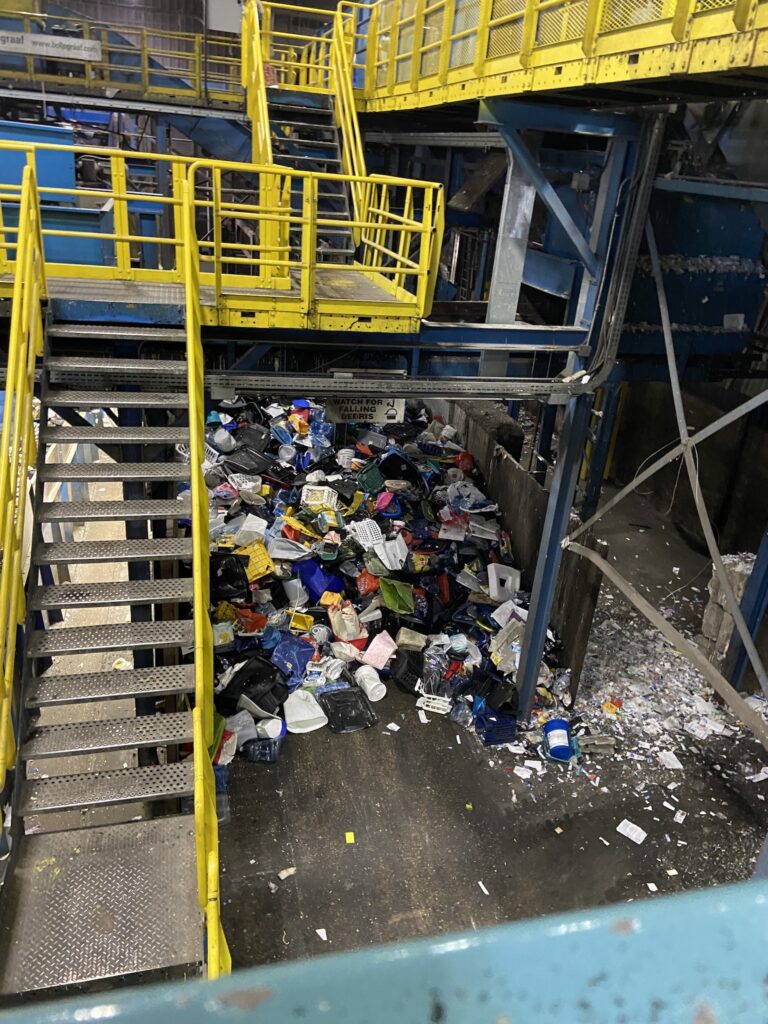
Each day after the recycling is collected, Greenbelt’s trucks drive directly to the MRF, are weighed, and then drive inside the building entrance to literally tip their loads onto, you guessed it, the tipping floor. It’s easy to see that everything is commingled, from loose paper and cardboard to plastic, glass and metals. From there, a loader scoops up the material into a drum feeder that pushes it at a consistent rate into the facility, where the rest of the magic happens.
Early in the process, the materials run through a system that uses air and rotating rollers with gears to push lighter materials like paper and cardboard up, like popcorn, over and off to a different conveyor, while bulky and heavier items like cans and bottles fall through the rollers to another part of the system. The cardboard and paper are separated and dropped into giant bins called bunkers. Once the right amount by weight is met, the material is pressed into large rectangular bales, wrapped with wire and moved to storage awaiting sale at the end of the month.
The plastic, glass and metals are conveyed through a series of rotating metal magnets that pull out items containing steel or iron. So-called tin cans are often made of steel with a tin plating to prevent rust, and at the end of the process, steel and tin are baled together for sale.
Next Steps
The next steps employ air, mechanical and laser optical sorters that recognize the different plastic resins, and separate out the glass and aluminum. The first pulls out containers made of polyethylene terephthalate (PET), which residents recognize by the recycling or resin code #1. Next, the conveyor passes through a color optical sorter, followed by an eddy current that pushes out the lighter weight aluminum. That is followed by more optical sorters that recognize polypropylene (PP, resin code #5).
While materials are pulled from the stream by machines, people also work as a last line of defense to ensure nonrecyclables do not get through. Bell said they’ve seen everything from car parts to diapers to bowling balls. It is a constant problem, but he added that only about 20 percent of materials that come in to the MRF tipping floor are sent to the landfill as nonrecyclable. The industry average is around 25 percent, he noted.
Finally, the separated plastics and metals are dropped into bunkers where they are compressed and, when the correct size by weight is reached, are baled and stored until the end of the month.
Glass
Glass is handled differently. Recycled glass in the mid-Atlantic region doesn’t often become new glass bottles. It’s one of the materials best used as close to the source as possible, due to transportation costs. In the past, crushed glass was often used as in ingredient in aggregate, for roads, or to cap off a landfill. Currently, the MRF sends all the sorted and crushed glass to Pennsylvania-based Cap Glass Recycling. According to their website, they process glass for single-stream recycling systems by taking over more of the production of crushed glass or cullet, as well as making abrasives and filtration materials.
Marketing
While the sorting goes on, MES’ recyclables marketing division handles the sale of recycled materials on a competitive basis, working with existing buyers and surveying the marketplace for new potential bidders. The baled plastics, metals and paper are generally sold on bid once a month, but MES works with some customers on a longer timeline.
Most of the paper baled at the MRF is shipped to Asia, which dominates the global pulp and paper market. Shipped via the port of Baltimore, it is the only material they export, Bell said. It’s basic economic geography; the bulk of global paper pulping operations are located in Asia, and it is a relatively inexpensive material to ship. Some paper bales are held back for smaller pulping operations in Georgia and Pennsylvania. Glass, by comparison, is heavy and expensive to ship, so it is used closer to home.
Knowing where or in what products the bales of PET or tin and steel will end up is like predicting the stock market, Bell said. The uses for PET, HDPE (high-density polyethylene, #2) or PVC (polyvinyl chloride, #3) and other plastics are widely dependent on changing global events.
Making It Easy
Ease of recycling for residents was key in Prince George’s County’s choice of a single-stream recycling system. Studies have shown that a simple, commingled method increases actual participation over other methods, particularly in more dense urban regions. In other counties, such as in Montgomery, a dual-stream curbside system has residents separate glass, bottles and cans from paper at the curb. In Virginia, glass is not recycled curbside; instead residents must take their glass bottles to locations with special purple bins.
Recycling Tips
Meanwhile, for residents of Greenbelt, other recycling tips the tour group picked up include:
• Put metal lids and small fish tins together in one larger can, and squeeze the top closed, which helps those smaller parts get through, instead of falling through the conveyor belts.
• Empty aerosol cans (to prevent fires in the factory) and throw away the plastic tips.
• Load shredded paper in a paper grocery bag and tape the top closed so it won’t fall through the machines but will be lightweight and large enough to be sorted out with the other paper.
• Rinse cans and jars; they don’t need to be squeaky clean, just rinsed, but peanut butter in plastic jars may be the exception. The purer the materials they put out for bid, the better the odds of sales, the price and the reputation of the facility for useable recycled materials. Every bit helps.
As for the perpetual statistic that only about 5 percent of plastic is recycled, consider the source (advocacy versus academic) as well as the specific material and geographic location ‒ there are parts of the United States where recycling is not collected, but requires a special trip to a specific site. EPA data from 2018 claims that while the overall rate was 3 million tons for 8.7 percent, 30 percent of both PET and HDPE (#1 and #2) were recycled.
Schedule a Tour
Both the Prince George’s County recycling and compost facilities welcome scheduled tours and often host school or civic groups. Tours are a good way to encourage recycling and dispel myths, says Bell. Call the MRF at 301-324-4760. Call the composting facility at 1-888-214-8687 between 8 a.m. and 3 p.m.