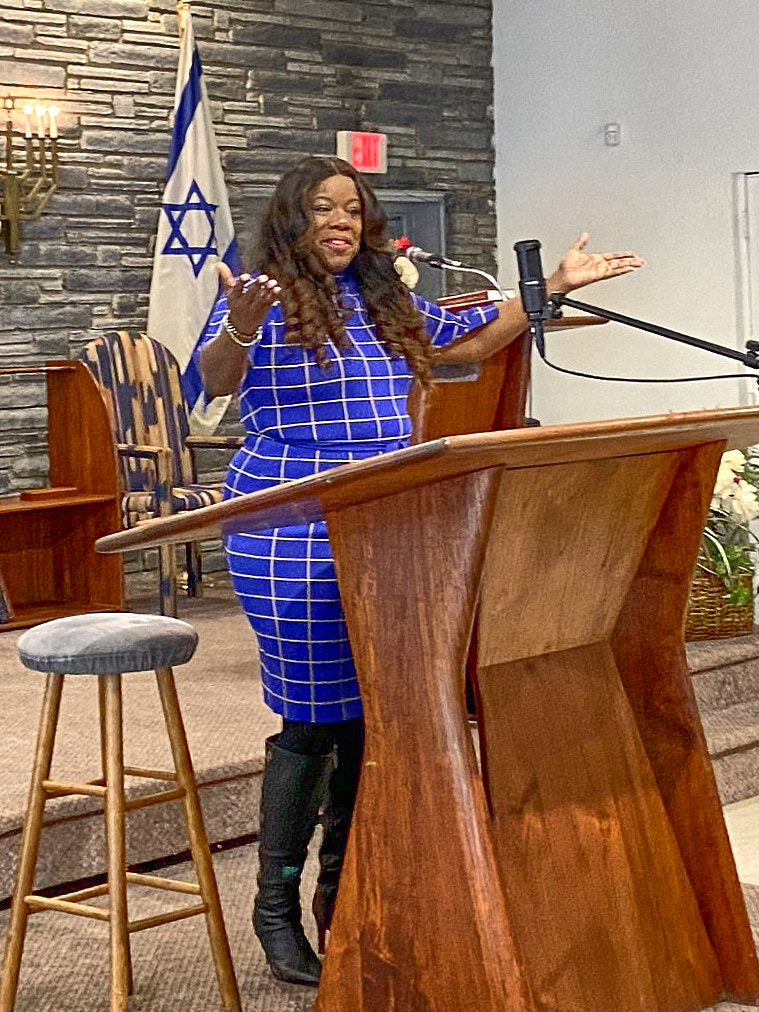
Greenbelt’s Mishkan Torah Synagogue hosted Prince George’s County Executive Aisha Braveboy for a community discussion on Sunday, February 8, with about 75 attendees from Greenbelt and beyond. It being the first time in 20 years a county executive visited Mishkan Torah, the audience was welcoming, though several substantive questions arose. The event included Braveboy’s prepared remarks about faith and local issues, queries of particular concern from Mishkan Torah and audience questions. Attendees included City Councilmembers Frankie Fritz, Emmett Jordan, Danielle McKinney, Jenni Pompi, Silke Pope and Kristen Weaver and City Manager Josué Salmerón. Mishkan Torah Men’s Club President Mark Shroder moderated the event.
Faith, Unity
Braveboy said she is a woman of faith and called religion a force for unity. She believes the American dream is for everyone, and it’s sad to see what’s happening to many seeking it. She said good people of all faiths unite for inclusion and civil rights, and cited the Jewish community’s history of doing so.
“You are valued, your families are valued and your religion is valued in Prince George’s County,” said Braveboy. Prince George’s County Police Chief George Nader monitors intelligence and incidents affecting the Jewish community and increases patrols accordingly, Braveboy added.
She said her June 2025 inauguration speech emphasized unity because recent past conflict among county officials did not help residents, especially amid federal divisiveness. She spoke about ensuring county residents “have a government they can believe in,” and resolving internal differences in favor of addressing external impacts on the county.
First Eight Months
Braveboy said her early results include reducing homicides by 40 percent and carjackings by 58 percent; increased hiring of police and fire personnel, 911 operators, teachers and some school bus drivers; and reducing by 90 percent a 28,000 backlog of 311 county service requests.
She said hiring interim county school superintendent Shawn Joseph was necessary because “disunity” between the school board, former superintendent and teachers’ union obstructed teacher contract negotiations, which they were in the midst of, and she sought someone who is a good listener and fair. She said Joseph and the union reached an agreement within three days of his appointment, leading to a contract and salaries that enabled the county to hire 1,000 teachers. Braveboy did not mention that the union contract negotiated under Joseph, among other items, has led to a 150-million-dollar deficit in the schools’ budget since Joseph took over. Nor did she speak to the large severance package of the former superintendent, which was released without any dollar amounts included, lacking fiscal transparency, and without being voted on by the Board of Education, which the Office of Integrity and Compliance determined “constitutes a separate and serious matter beyond the scope of this Management Advisory.” Referencing Joseph possibly applying for the permanent superintendent position, Braveboy pledged public processes to vet and select candidates and said a vetting team has been chosen.
Promoting commercial development for tax revenue, she took credit for the Sphere planned for National Harbor, an event venue with a wraparound immersive LED screen similar to the larger Las Vegas Sphere, predicting $1.6B in economic impact, including 3,000 construction jobs, 4,000 permanent jobs including technology and creative professions and opportunities for local businesses.
Speaking directly to Greenbelters, she called for “waiting this president out” by making needed investments to prepare for bringing the FBI headquarters to Greenbelt. She sees an exciting future for Prince George’s, a talented, smart community with a lot to offer, whose story it’s her job to tell, a story she said is getting noticed and producing results, with more announcements to come.
Development
When Shroder asked Braveboy what the county executive can do for affordable housing, she said since the county has the most underdeveloped Metro stations in the region, transit-oriented development makes sense for new, quality affordable housing, as well as infill development in established communities. She said Washington Metropolitan Area Transit Authority (WMATA) has chosen developers for the areas around the Capitol Heights and Addison Road Metro stations, and that she’s focused on helping developers include retail with residential developments so residents can spend their money where they live.
She wants to invest in health sciences and technology businesses, and grow the local sports economy with a sports innovation hub for training, competitions and community use near the Morgan Boulevard Metro station as the Washington Commanders prepare to depart Northwest Stadium for Washington, D.C. She spoke of redeveloping the Northwest Stadium area and the empty Six Flags site to add services to directly benefit Prince Georgians and add tax revenue.
BARC, NASA, Climate
Regarding the Beltsville Agricultural Research Center (BARC) and NASA, Braveboy said she believes the federal government has realized it can’t close BARC. Speaking about federal attempts to cut science programs and move government facilities from the region, she said to applause that, “We have to resist the goals of the administration,” and that she will work with persons of any political party to address shared human needs for family, work and childcare.
About protecting the remaining green belt, Braveboy said BARC land is protected. Mayor Emmett Jordan said changing BARC land use requires congressional action, and that the city council and city manager are working to annex the land to give Greenbelt a voice in any land use decisions, adding “We’re doing everything we possibly can to protect that land.”
Resident Kathy Bartolomeo asked Braveboy what actions her administration is taking to cut greenhouse gas emissions. Braveboy said a Department of the Environment task force is implementing a county climate change plan, and invited Bartolomeo to participate by contacting department deputy director Derrick Coley. The 2022 Climate Action Plan on the department website calls for cutting greenhouse gas emissions by 50 percent (from 2005 levels) by 2030 and achieving carbon neutrality by 2050.
Data Centers
Shroder asked Braveboy whether and where data centers should be built in the county. Though she didn’t answer whether they should be built here, she said they shouldn’t be in residential areas but could be in areas that won’t impact how people live. Braveboy said some county residents welcome a data center replacing a rubble field.
She said since the county shares a regional electricity grid with other jurisdictions that are choosing to build data centers, Prince George’s is impacted by increased electricity costs without the data center tax revenue obtained by those jurisdictions. “We have to be honest and talk about it.”
Referencing the county council’s November 2025 data center task force recommendations, she said choosing locations must be a public process, using overlay zones to designate areas appropriate for data centers. She added, “Negotiations will be very public, the public will have to know where data centers will be sited.” November 2025 reporting from Maryland Matters described the task force report as indicating data centers will be welcome in the county, under certain circumstances and via community approval processes.
Bartolomeo requested Braveboy’s position on hyperscale data centers, to which Braveboy said, “I don’t think we’ve gotten there yet in terms of discussions, but I don’t think there’s any reason to be secretive about what’s going to happen in your neighborhoods. It doesn’t make sense in my opinion. I think everything should be above board and people should know. If you want to build something in an area, you should tell the people.”
Bartolomeo asked whether Braveboy supports prohibiting nondisclosure agreements (NDAs) between data center developers and public agencies, upon which Braveboy asked, “Why would they have NDAs?” Bartolomeo explained NDAs are often part of data center development negotiations. Braveboy said she doesn’t believe the county council’s data center task force contemplates NDAs, instead expecting a public overlay zone process to allow residents to know in which areas data centers could be built. [Creating overlay zones doesn’t preclude NDAs for potential projects. The task force report documents multiple public comments against NDAs.]
Small Businesses
Riverdale Park small business owner Jonathan Katz-Ouziel spoke of cumbersome processes that hinder doing business with the county, requiring multiple steps with multiple agencies that don’t talk to each other, and of rules further hindering small businesses. He asked about enabling small businesses to “do business with the place where we live.” Braveboy said she is moving all procurement to a single office with one procurement policy, to enable holding one agency accountable. She said Procurement Director Alice Williams, who can restrict bids to small businesses, meets at least weekly with small businesspersons and recommended Katz-Ouziel meet with Williams.
Government Accountability
A Cheverly parent requested dashboards to make county service data transparent to residents, saying it is difficult to communicate with county government for accountability and figure out what to do when things go wrong. Her examples were difficulty obtaining county permits, which impedes housing and businesses and with Prince George’s County Public Schools (PGCPS), speaking about a school bus catching fire shortly after her child exited the bus. “I couldn’t find a single person to talk to about my child being in a school bus that was on fire,” she said. She noted the inability to interrogate the school system about bus fires without bus safety data or to ask the permit office about how long it’s taking to inspect a property without access to permit data.
Braveboy said the Department of Permitting, Inspection and Enforcement (DPIE) has created a small business division to expedite review for projects under 5,000 square feet, that DPIE is implementing processes for staff to engage individuals whose permits aren’t moving and that data sources are being identified to create dashboards.
Braveboy apologized for the parent’s school bus experience and said PGCPS operates independently of the county administration. She said the administration can model transparent behaviors for other agencies to adopt and asked the parent to contact her.
Education
A second Cheverly parent asked Braveboy to identify challenges PGCPS faces and her goals. She said a big challenge is serving special needs students, for whom late diagnoses can increase their needs and the cost to support them, so she and County Council Chair Krystal Oriadha are launching an early detection initiative. She said finding teachers and counselors for English learners is a challenge, as is increasing their standardized test scores to increase county scores. She also noted many students are excelling, and many parents and children love their schools.
Public Health, Religion
Shroder asked what the county executive can do about public health and the next pandemic, particularly in relation to religious communities, saying Mishkan Torah had two years without in-person services during Covid-19. Braveboy said she can facilitate discussion, follow the science, respect religious needs and identify alternatives, because it’s “difficult for people to not be together to praise and serve God.”
Transportation, Access
City Councilmember Frankie Fritz requested Braveboy’s help in adding a Capital Bikeshare (CB) station at Greenbelt Metro, saying the already budgeted project has been repeatedly delayed. He called Greenbelt Metro the most important CB station in Greenbelt, since transit systems don’t work if they’re not connected. Braveboy pledged to follow up with Fritz and the county Department of Public Works.
Hyattsville resident Gloria Cline-Smythe asked for Braveboy’s advocacy to add Sunday MetroAccess service for the elderly and disabled. She said, “Sunday morning is when I have my daily bread. All I want is to get to church.” Braveboy said she hears this from seniors countywide and pledged to talk with WMATA about whether “their current policy is the right policy.”
Open Communication Channels
Braveboy said she was open to hearing from constituents and addressing the ideas and needs she heard at Mishkan Torah. She encouraged contacting her assistant Tracy Holland by email at tjholland@co.pg.md.us, and Deputy Chief Administrative Officer for Government Operations Chris Osuji also said he was available at cosuji@co.pg.md.us.