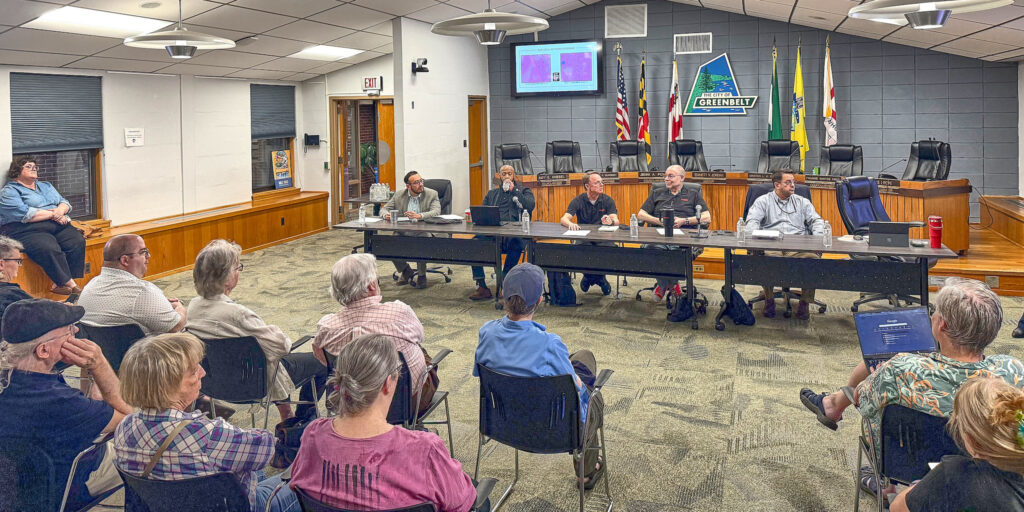
The Greenbelt City Council’s January 5 worksession was devoted to the issue of cellphone coverage gaps. Mayor Emmett Jordan introduced the issue as one of reliability and reach of cellphone coverage in the city, about which residents have complained in the past (see the December 18, 2025 issue). “While carrier maps show near-perfect coverage in Greenbelt,” Jordan continued, “our neighbors report dropped calls and dead zones; so, we need to move on beyond these discrepancies and create a roadmap to address the reality of cellphone coverage and begin to look at our city’s digital infrastructure more broadly.”
Coverage Discrepancy
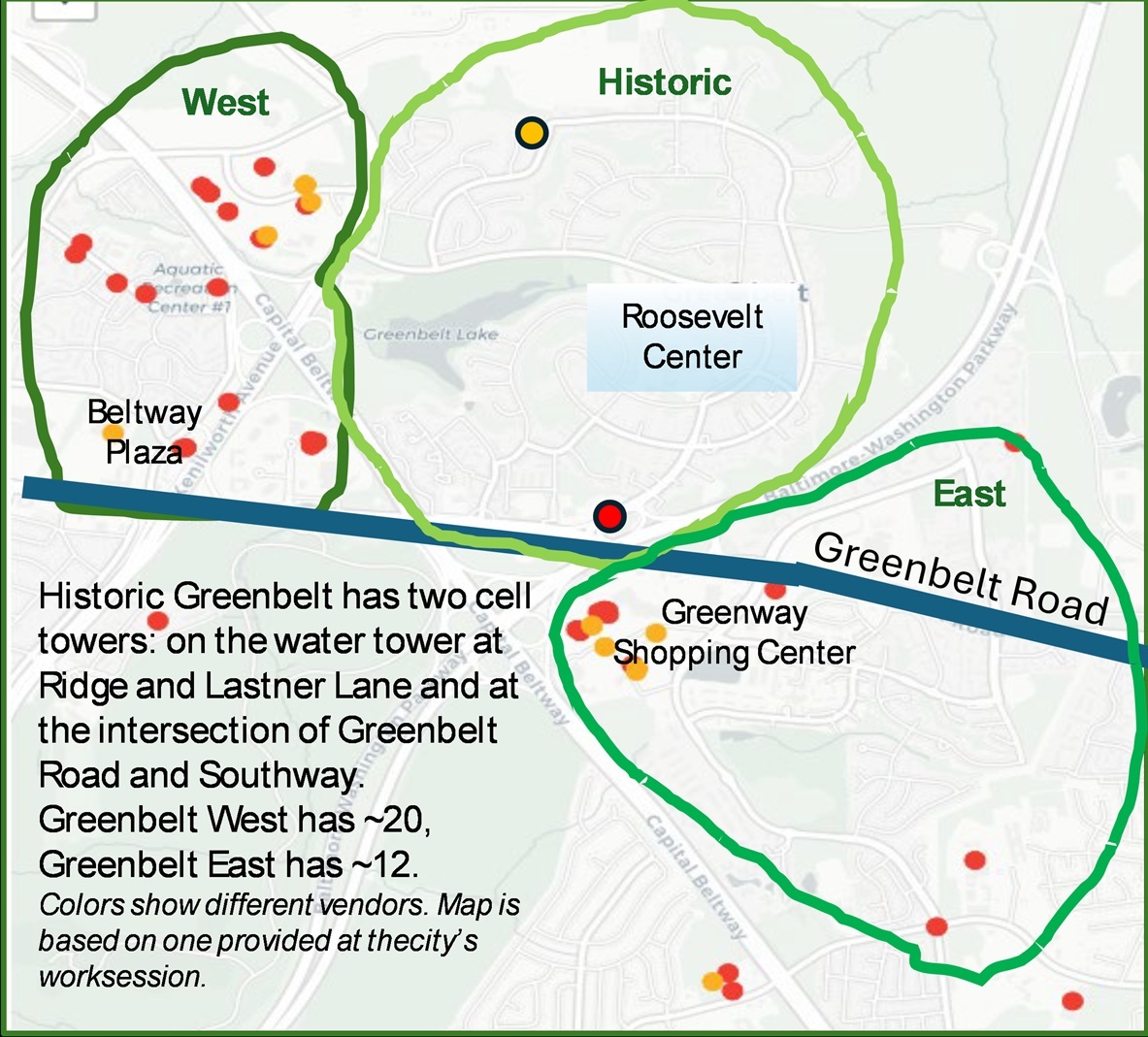
City Manager Josué Salmerón presented a map of existing cellphone towers in Greenbelt. “Despite an abundance of towers around Greenbelt,” he noted, “the area that lacks coverage is Greenbelt Center.” Salmerón also presented the three carrier maps mentioned by Jordan. All three ‒ from Verizon, T-Mobile and AT&T ‒ claim to have 4G or 5G coverage in the entire city, including Greenbelt Center. Salmerón suggested that the lack of coverage is very likely due to a lack of cell towers or antennas. Later in the discussion, two councilmembers reported hearing that staff at Greenbelt Elementary School also lack cellphone service.
Eight years ago, residents successfully opposed putting a cellphone tower near Eleanor Roosevelt High School (see the May 4, 2017 issue). But at present, Salmerón noted, resident sentiment is largely in favor of towers or other action to improve center city coverage. He said that a government-relations representative from Verizon was invited to attend, but was not present. The Zoom link to the meeting had not been posted prior to the meeting, so some residents missed some if not all of the worksession and there was a problem with sound on part of the video recording of the meeting. Because of these issues, two residents appeared midway through the meeting to comment and add information.
Report Complaints
The worksession benefited from a great deal of information and research from Salmerón and his administration staff, and yielded some ideas and suggestions from Jordan, councilmembers and a few residents. Council did not, however, make any formal decisions as to how to proceed with addressing the problem.
For resident problems with cellphone service, Salmerón suggested that specific complaints should be reported directly to cellphone service providers. Providers can pinpoint the locations of problems and determine how to address them. Jordan asked if the city could survey residents and submit to providers a detailed list of problems, specific addresses, problem location (inside or outside homes), and the types of cellphone they use. A problem, Salmerón answered, is that data collected by the city would become public and pose an invasion of privacy. To avoid this, the data collected by the city should be carefully limited.
It would be better if residents reported the problems themselves, Salmerón explained. The city could distribute a “how-to” instruction sheet to make it easy for them to do so. If a provider does not or cannot resolve a resident’s problem, the resident could switch to another provider. He was confident that, with competition among providers, they should be willing to do what is needed. Greenbelt’s administration has had problems with Verizon, he recalled, but T-Mobile is very responsive, easy to work with and willing to help Greenbelt with Smart City technology.
This problem also applies to broadband ‒ i.e., high-speed internet ‒ service, for which demand has increased in Greenbelt, including Greenbelt Center, according to city administration research. At one time many merchants wanted Verizon to provide broadband, but Verizon refused because that would have required improving its technology infrastructure. Some businesses currently use Comcast for broadband service.
Potential Sites
To resolve problems, more antennas and/or cell towers might be needed. Councilmembers Kristen Weaver and Danielle McKinney discussed the possibility of comparing Greenbelt’s number and distribution of cell towers to those of cities with comparable geographical size and population to determine the extent to which Greenbelt has coverage gaps and why. One available comparison between Greenbelt’s map of cellphone towers with Hyattsville’s map shows that Greenbelt has clusters of towers, whereas Hyattsville’s towers are more evenly distributed throughout the city. The clusters of towers are in areas of high vehicle counts, i.e., near the Capital Beltway and the intersection of the Baltimore-Washington Parkway and Greenbelt Road.
If Greenbelt needs to explore the possibility of more antennas or cellphone towers, Salmerón recommended, the city should work with a consultant to select the most strategic sites. Once it identifies those sites and makes space available, it will then need the service providers to install the needed infrastructure. If the city announces that it has available sites, it should, in the interest of fairness and competition, include all providers. Competition typically yields better service.
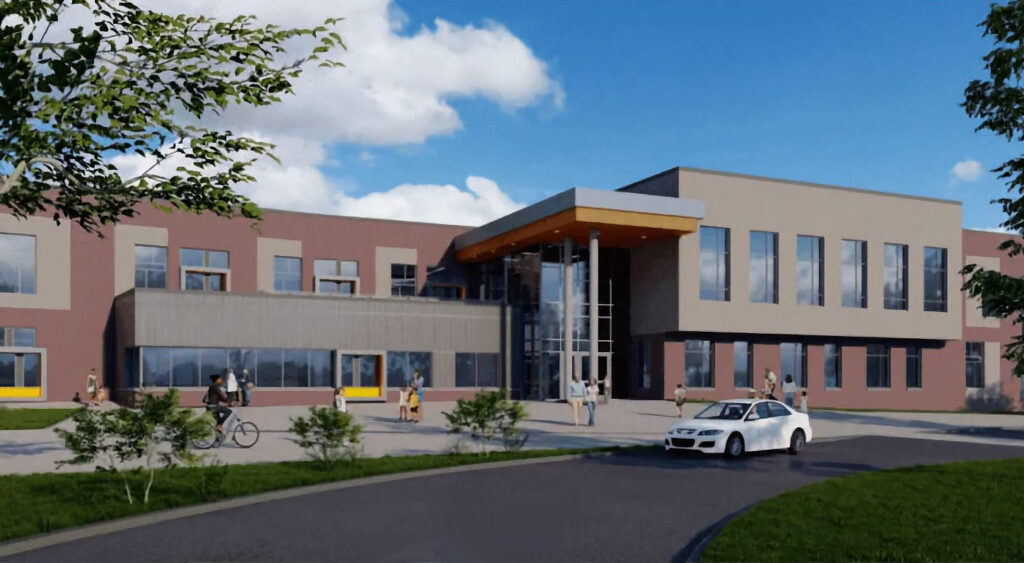
Discussion followed among councilmembers and Salmerón about locations for new antennas; one idea is to attach them to street lamp posts (with Pepco’s approval or transfer of ownership to Greenbelt). All agreed that Greenbelt’s tree canopy might interfere with coverage on the ground. A few options suggested by Salmerón for antennas or small towers on higher ground include Greenbelt Elementary School (if approved by Prince George’s County Public Schools), the water tower, churches, police and fire stations, and light poles at Braden Field. If many antennas are needed, a single tower might actually be more cost-effective.
Next Steps
Toward the end of the discussion, Councilmember Jenni Pompi said, “We already know there is a problem … so we should start working toward solving it … and exploring the paths that are open to us.” Others suggested that council get expert help with siting additional towers or antennas, get providers to help with technical issues and explore grant possibilities for improving phone service and access to broadband.
Salmerón stated that he and staff will work to explore these paths.